
Human Organoids #
Organoids are three-dimensional, self-organizing cultures derived from stem cells that recapitulate the structure and function of human organs. This section showcases how organoids are transforming disease modeling, drug screening, and gene therapy development, enabling precision medicine approaches for conditions like cystic fibrosis, Duchenne muscular dystrophy, and cancer.
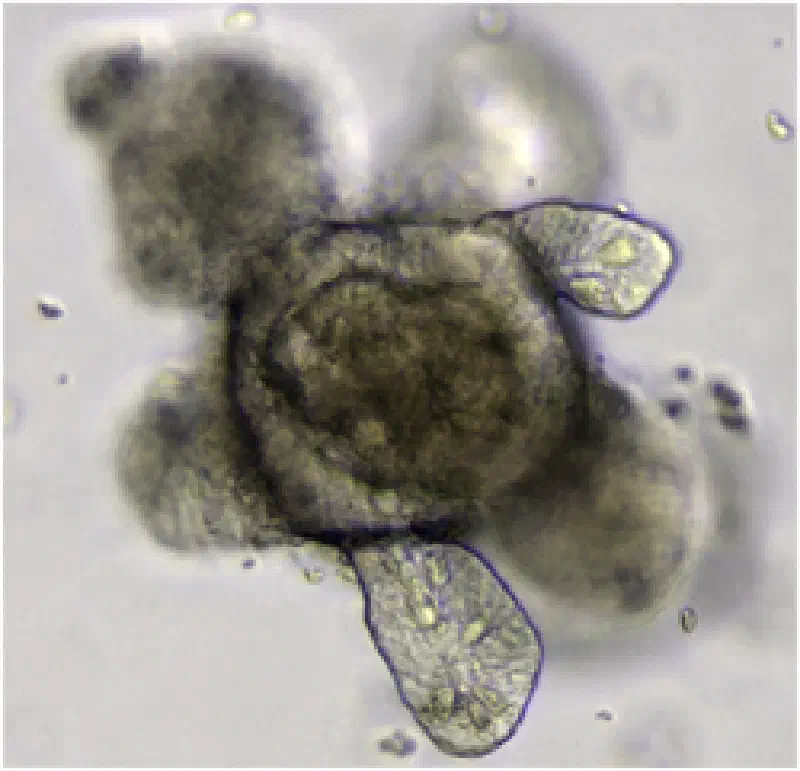
from Lgr5+ stem cells.
Credit: Meritxell Huch, CC BY 4.0
FIS Assay for Cystic Fibrosis #
Patient-derived intestinal organoids from Cystic Fibrosis patients were used in the Forskolin-induced Swelling (FIS) assay to test CFTR-modulator drugs. The assay accurately predicted clinical trial responses for individual patients, including those with rare genotypes. This has enabled tailored therapeutic strategies, significantly increasing life expectancy for Cystic Fibrosis patients.1 2
Patient-Derived Organoids for Gene Therapy in DMD #
A breakthrough workflow successfully converted cryopreserved blood cells into induced pluripotent stem cells and then into cardiac organoids, correcting unique splicing defects in Duchenne Muscular Dystrophy patients. Custom ASOs restored dystrophin expression and improved calcium transients in these cardiac organoids, validating the therapeutic approach. This provided a scalable, cost-effective alternative to animal models for developing personalized gene therapies.3
Patient-Derived Organoids for Metastatic Colorectal Cancer #
The OPTIC trial validated the predictive power of patient-derived organoids (PDOs) for metastatic colorectal cancer, showing that organoid response correlated with radiological tumor response and clinical survival. The trial demonstrated 83.3% accuracy in predicting patient survival and tumor response. This has enabled early identification of ineffective therapies, minimizing patient exposure to toxicity and optimizing treatment selection.4
Organoid Immune Co-Culture Models for Cancer Vaccines #
Tumor organoids co-cultured with autologous peripheral blood lymphocytes simulated the tumor immune microenvironment to assess individual responses to checkpoint inhibitors and CAR-T cell therapies. This method identified tumor-specific antigens with high immunogenicity, enabling the design of personalized cancer vaccines. The discovery has revolutionized immunotherapy development by capturing spatial organization and immune dynamics.5
Kidney Assembloids for Polycystic Kidney Disease #
Researchers generated the most complex kidney structures to date—assembloids combining filtering nephrons with urine-concentrating collecting ducts. These assembloids recapitulated key features of Polycystic Kidney Disease, including inflammation and fibrosis, which were previously irreproducible in animal models. This work opened new avenues for studying chronic kidney disease and predicting drug-induced nephrotoxicity.6
Miller-Dieker Syndrome Root Cause #
Human brain organoids derived from patient cells identified the root cause of Miller-Dieker Syndrome as early neural stem cell death and severe division defects in “outer radial glia.” Time-lapse imaging showed that these specific glia cells—which are entirely absent in mouse models—failed to divide properly. This solves a long-standing mystery in neurodevelopmental disease and proves that patient-derived organoids can bridge the gap between animal models and human pathophysiology.7 8
IGF-1 Dependency in Lung Cancer Subtypes #
A library of 40 small cell lung cancer (SCLC) organoid lines revealed that non-neuroendocrine subtypes depend on the IGF-1 signaling axis for growth. Genetic ablation in human alveolar organoids replicated this dependency, and IGF1R inhibitors suppressed growth in patient-derived models. This identifies IGF1R inhibition as a promising new therapeutic strategy for a treatment-resistant patient population.9
Intestinal Organoids Reveal Stem Cell Biology #
The first human intestinal organoids developed from adult stem cells enabled the study of gut disease, cancer, and drug responses in human tissue. This success was extended to liver, kidney, brain, and retinal organoids worldwide, validating the platform across multiple organ types. This technology serves as the foundation for modern human organoid research.10
Brain Organoids Model Microcephaly Caused by Zika Virus #
Human brain organoids demonstrated Zika virus infection of neural progenitor cells, modeling microcephaly-like features in human tissue. The organoids captured human-specific features of microcephaly that mouse models were unable to fully recapitulate. This provided critical, human-specific insights into Zika virus pathology.11 12
Understanding Brain Development and Disease #
Brain organoids, three-dimensional, laboratory-grown models derived from induced pluripotent stem cells that replicate the complex, species-specific developmental programs of the human brain, have revolutionized neuroscience by allowing researchers to study the unique expansion of the human cortex. Organoids serve as critical tools for modeling neurodevelopmental disorders such as autism and microcephaly, testing treatments, and exploring evolutionary differences through the integration of ancient hominin genes. Regional organoids are fused into “assembloids” to map functional neural circuits, including motor-muscle connections and pain-processing pathways. Despite their transformative potential, organoids currently lack the full complexity of a natural brain and face long-term sustainability challenges, which, alongside improving technology, necessitates ongoing ethical scrutiny regarding the future possibility of emergent sentience.13
References #
-
UMC Utrecht Research, Towards diagnostic and personalized models using organoids, UMC Utrecht, 2023
Discusses the development of new models and approaches to simulate human diseases in the lab, highlighting the use of organoids for diagnostic and personalized medicine. ↩︎ -
Barnes K, NAMs: an exciting era for drug discovery, BioTechniques, 2025
Highlights how new approach methodologies (NAMs) are addressing the gaps in drug discovery studies and creating more human-relevant approaches. ↩︎ -
MarinBio, Patient-Derived Organoids for Gene Therapy Development, MarinBio, 2024
Details a breakthrough workflow converting cryopreserved blood cells into cardiac organoids to correct splicing defects, providing a scalable alternative to animal models for personalized gene therapies. ↩︎ -
Smabers LP, et al., Patient-Derived Organoids Predict Treatment Response in Metastatic Colorectal Cancer, Clinical Cancer Research, 2025
Validates the predictive power of patient-derived organoids (PDOs) for metastatic colorectal cancer, demonstrating high accuracy in predicting patient survival and tumor response to optimize treatment selection. ↩︎ -
Chen K, et al., From petri dish to patient care: organoids bring personalised cancer therapy closer, ecancer, 2025
Reviews how tumor organoids co-cultured with autologous lymphocytes simulate the tumor immune microenvironment, enabling the design of personalized cancer vaccines and revolutionizing immunotherapy development. ↩︎ -
Foster B, Researchers develop most advanced kidney organoid yet for disease modeling and drug discovery, Drug Discovery News, 2025
Reports on the generation of complex kidney assembloids combining filtering nephrons with collecting ducts, recapitulating key features of Polycystic Kidney Disease previously irreproducible in animal models. ↩︎ -
Iefremova V, et al., An Organoid-Based Model of Cortical Development Identifies Non-Cell-Autonomous Defects in Wnt Signaling Contributing to Miller-Dieker Syndrome, Cell Reports, 2017
Identifies the root cause of Miller-Dieker Syndrome as early neural stem cell death and division defects in outer radial glia, solving a long-standing mystery in neurodevelopmental disease. ↩︎ -
Niehaus I, et al., Cerebral organoids expressing mutant actin genes reveal cellular mechanism underlying microcephaly, EMBO Reports, 2025
Reveals the cellular mechanisms underlying microcephalic cortical malformation using cerebral organoids expressing mutant actin genes, bridging the gap between animal models and human pathophysiology. ↩︎ -
Fukushima T, et al., An organoid library unveils subtype-specific IGF-1 dependency via a YAP–AP1 axis in human small cell lung cancer, Nature Cancer, 2025
Identifies that non-neuroendocrine subtypes of small cell lung cancer depend on the IGF-1 signaling axis for growth, establishing IGF1R inhibition as a promising therapeutic strategy. ↩︎ -
Sato T, Vries RG, Snippert HJ, et al., Single Lgr5 stem cells build crypt-villus structures in vitro without a mesenchymal niche, Nature, 2009
Describes the foundational development of the first human intestinal organoids from adult stem cells, enabling the study of gut disease, cancer, and drug responses in human tissue. ↩︎ -
Qian X, Nguyen HN, Song MM, et al., Brain-Region-Specific Organoids Using Mini-bioreactors for Modeling ZIKV Exposure, Cell, 2016
Demonstrates Zika virus infection of neural progenitor cells in human brain organoids, modeling microcephaly-like features and capturing human-specific pathology that mouse models could not fully recapitulate. ↩︎ -
Science News, Zika virus tested in human brain organoids, Science, 2016
Reports on the critical insights gained from testing Zika virus in human brain organoids, highlighting the technology’s ability to model congenital viral effects on human neural development. ↩︎ -
Abbott A, Mini models of the human brain are revealing how this complex organ takes shape, Nature, 2026
Explores how lab-grown brain organoids are turbo-charging the study of human brain development, serving as critical tools for modeling neurodevelopmental disorders while raising important ethical considerations. ↩︎