
Organ on a Chip #
Organ-on-a-chip and microphysiological systems replicate the dynamic, multi-cellular environments of human organs in microfluidic devices, enabling high-fidelity studies of drug effects, disease mechanisms, and toxicity. By mimicking tissue-tissue interfaces, fluid flow, and mechanical forces, these platforms offer human-relevant alternatives to traditional animal models, driving advances in personalized medicine and regulatory-approved drug development tools.
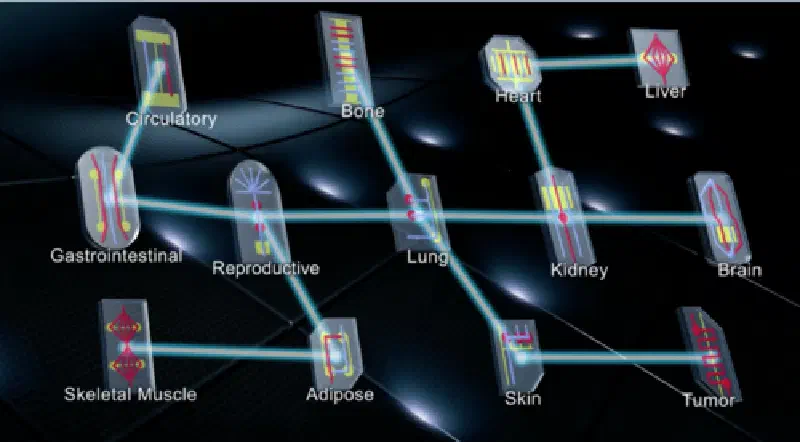
to simulate a human-body-on-a-chip.
Credit: NCATS.
Emulate Liver-on-a-Chip Identifies Hepatotoxicity #
The Emulate liver-on-a-chip model correctly identified hepatotoxicity in 87% of drugs (see “performance assessment” link below) that had tested as safe in animal models but were later found toxic in humans. The platform recapitulated human-specific metabolic dynamics, including albumin secretion and mechanical stimuli in the extracellular matrix, validating its biological accuracy. This success highlighted the superiority of human-relevant microphysiological systems over animal models for predicting drug-induced liver injury.1 2 3
Acetaminophen Toxicity Mechanism #
Liver-on-a-chip technology equipped with nanotechnology-based optoelectronic sensors identified that acetaminophen blocks cellular respiration in minutes at much lower doses than previously believed. Sensors placed inside the bionic tissue detected rapid changes in oxygen uptake, revealing an ultra-rapid mitochondrial respiration impairment component not captured in legacy in vivo studies. This discovery provides a human-specific explanation for rare off-target effects and skin reactions, transforming safety protocols for one of the world’s most common medications.4 3
Lung-on-a-Chip for Antiviral Efficacy #
A human lung-on-a-chip system was used to test RNA-based antiviral therapies for influenza, showing significant reduction in viral replication and inflammatory responses with minimal off-target toxicity. The platform demonstrated efficacy and safety under physiologically relevant conditions such as air-liquid interface and dynamic flow. This provided a human-relevant platform for antiviral drug testing, successfully overcoming the limitations of static cultures and animal models.5 6 7
Lung-on-a-Chip for Tumor Heterogeneity & Drug Resistance #
Microfluidic lung-on-a-chip platforms modeled lung cancer microenvironments, enabling label-free real-time classification of tumor cells and the tracking of drug-resistant subpopulations like EGFR mutations. The technology demonstrated the ability to observe tumor heterogeneity and resistance dynamics in a human-relevant system, validating its predictive power. These insights have accelerated the development of targeted therapies and personalized treatment strategies for lung cancer.8 9 10
Liver and Skin Organ-on-a-Chip for PK-PD Studies #
The HUMIMIC Chip2 integrated liver spheroids and skin models to study pharmacokinetic-pharmacodynamic (PK-PD) relationships under chemical exposure. The platform’s utility for quantifying drug metabolism and toxicity was validated in a human-relevant, multi-organ context. This advancement directly supported regulatory acceptance of organ-on-a-chip technologies as essential drug development tools.11 12
ALS Pathogenesis and Early Biomarkers #
Human spinal cord organ-chips integrated with vascular interfaces modeled early sporadic Amyotrophic Lateral Sclerosis (ALS), uncovering neurofilament dysregulation and synaptic signaling defects. Multi-omics analysis confirmed these molecular changes occur before overt neuron loss, mirroring clinical biomarkers that are difficult to detect in animal models. This technology offers a human-relevant platform to study early disease progression and identify therapeutic targets before irreversible nerve damage occurs.13 14
GABAergic Signaling in Cancer Invasion #
Patient-derived tumor organ-chips proved that tumor-derived GABA acts as a marker of poor prognosis and directly promotes invasion in metastatic colorectal cancer. Interrogating the underlying biology on-chip demonstrated that inhibiting GABA synthesis significantly reduced invasive behavior, capturing patient-specific heterogeneity more faithfully than static cultures. This work establishes a new therapeutic target for colorectal cancer and validates the ability of organ-chips to replicate the complex tumor microenvironment.15
Cervical Protective Role in Dysbiosis #
Linked Cervix and Vagina Organ-Chips demonstrated that cervical mucus actively modulates vaginal inflammation and protects the epithelium from injury during dysbiosis. Exposure to cervix-derived mucus on-chip reduced inflammatory responses and altered protein expression profiles, identifying potential new biomarkers for bacterial vaginosis. This discovery uncovers human-specific protective mechanisms that cannot be studied in animal models, facilitating the discovery of new feminine health therapeutics.16
Lung-on-a-Chip Replicates Human Lung Disease and Drug Responses #
Microfluidic chips lined with human lung cells modeled pulmonary edema, COPD, and drug toxicity with high fidelity. This model demonstrated superior predictive value over animal models for lung disease and toxicity and is now recognized by the FDA as a valid testing platform for specific drug submissions. The impact of this technology is the enablement of more accurate modeling of human lung responses to drugs and diseases.17 18
Human Skin-Lymphoreticular Model-on-Chip for Inflammatory Skin Diseases #
Researchers developed a human-based skin-lymphoreticular model-on-chip emulating inflammatory skin conditions by capturing immune-skin interactions on a microfluidic platform. The utility for studying atopic dermatitis and related diseases was validated through the observation of complex cellular interactions. This advancement effectively eliminates the need for animal models in studying inflammatory skin diseases.19
References #
-
Yang H, et al., Tumor organoids for cancer research and personalized medicine, Cancer Biology & Medicine, 2021
Reviews the development and application of tumor organoids in modeling cancer biology, drug screening, and personalized medicine, highlighting their advantages over traditional 2D cultures. ↩︎ -
Ewart L, et al., Performance assessment and economic analysis of a human Liver-Chip for predictive toxicology, Communications Medicine (Nature), 2022
Evaluates the predictive accuracy and economic viability of the Emulate Human Liver-Chip, demonstrating its superiority over animal models in identifying hepatotoxicity and its potential to reduce drug development costs. ↩︎ -
Science Advancement and Outreach Division, What are NAMs?, Science Advancement, 2023
Provides an overview of New Approach Methodologies (NAMs), including organ-on-a-chip and in vitro models, explaining their role in replacing animal testing and improving human-relevant scientific research. ↩︎ ↩︎ -
Yu Y, et al., Hepatotoxic assessment in a microphysiological system, Food and Chemical Toxicology, 2024
Details the use of microphysiological liver systems to assess hepatotoxicity, showcasing the platform’s ability to capture human-specific metabolic responses and mitochondrial impairments that static cultures miss. ↩︎ -
Konar D, et al., Lung-On-A-Chip Technologies for Disease Modeling and Drug Development, Biomedical Engineering and Computational Biology, 2016
Explores the engineering and biological applications of lung-on-a-chip devices, emphasizing their utility in replicating the air-liquid interface and mechanical breathing motions for disease modeling. ↩︎ -
Physicians Committee for Responsible Medicine (PCRM), Human Lung-on-a-Chip Model Demonstrates Potential for Testing Preclinical Influenza Therapeutics, PCRM News, 2023
Highlights the successful use of a human lung-on-a-chip to test RNA-based antiviral therapies for influenza, demonstrating reduced viral replication and minimal off-target toxicity under physiological conditions. ↩︎ -
Wang H, et al., Advances of microfluidic lung chips for assessing airborne toxicological potential, Environment International, 2023
Discusses the paradigm shift in respiratory research brought by microfluidic lung models, focusing on their ability to model complex pulmonary diseases and accelerate drug discovery. ↩︎ -
Li L, Bo W, Wang G, Zhang H, Progress and application of lung-on-a-chip for lung cancer, Frontiers in Bioengineering and Biotechnology, 2024
Reviews the application of lung-on-a-chip platforms in oncology, specifically in modeling the tumor microenvironment, tracking drug resistance, and studying tumor heterogeneity in real-time. ↩︎ -
Lin KC, Yen CZ, et al., Airborne toxicological assessment: The potential of lung-on-a-chip as an alternative to animal testing, Materials Today Advances, 2022
Analyzes the regulatory and scientific potential of lung-on-a-chip systems to replace animal models in pulmonary toxicity testing, highlighting their human-relevant predictive capabilities. ↩︎ -
Liu J, et al., Advances in organ‐on‐a‐chip for the treatment of lung cancer, MedComm – Biomaterials and Applications, 2023
Examines how microfluidic models bridge the gap between in vitro studies and clinical outcomes by accurately recapitulating the lung tumor microenvironment and fluid dynamics. ↩︎ -
Deng S, Li C, Cao J, et al., Organ-on-a-chip meets artificial intelligence in drug evaluation, Theranostics, 2023
Investigates the integration of AI with organ-on-a-chip technologies to enhance data analysis, predict pharmacokinetic-pharmacodynamic (PK-PD) relationships, and streamline drug evaluation. ↩︎ -
Roy N, Cucullo L, Organs-on-Chips in Drug Development: Engineering Foundations, Artificial Intelligence, and Clinical Translation, Biosensors, 2026
A comprehensive review of the engineering principles, AI integration, and clinical translation of multi-organ chips, emphasizing their role in modernizing regulatory drug development frameworks. ↩︎ -
Genetic Engineering & Biotechnology News, Organ-Chip ALS Model Uses Patient iPSCs to Uncover Early Disease Progression, GEN, 2025
Reports on the use of patient-derived iPSCs in a spinal cord organ-chip to identify early molecular biomarkers of ALS, such as neurofilament dysregulation, before overt neuron loss. ↩︎ -
Lall D, Workman MJ, Sances S, et al., An organ-chip model of sporadic ALS using iPSC-derived spinal cord motor neurons and an integrated blood-brain-like barrier, Cell Stem Cell, 2025
Details the development of a human spinal cord organ-chip using induced pluripotent stem cells to model sporadic ALS, revealing early synaptic signaling defects and vascular interface abnormalities. ↩︎ -
Strelez C, Battaglin F, et al., GABAergic signaling contributes to tumor cell invasion and poor overall survival in colorectal cancer, Oncogene, 2025
Demonstrates how patient-derived tumor organ-chips identified tumor-derived GABA as a driver of invasion in metastatic colorectal cancer, establishing it as a novel therapeutic target. ↩︎ -
Gutzeit O, Gulati A, Izadifar Z, et al., Cervical mucus in linked human Cervix and Vagina Chips modulates vaginal dysbiosis, npj Women’s Health, 2025
Utilizes linked cervix and vagina organ-chips to prove that cervical mucus actively protects the vaginal epithelium from inflammation during dysbiosis, uncovering human-specific protective mechanisms. ↩︎ -
Huh D, Matthews BD, Mammoto A, Montoya-Zavala M, Hsin HY, Ingber DE, Reconstituting Organ-Level Lung Functions on a Chip, Science, 2010
The foundational paper demonstrating that a microfluidic lung-on-a-chip can replicate cyclic mechanical breathing and organ-level lung functions, including inflammatory responses and nanoparticle absorption. ↩︎ -
Huh D, Leslie DC, Matthews BD, et al., A Human Disease Model of Drug Toxicity–Induced Pulmonary Edema in a Lung-on-a-Chip Microdevice, Science Translational Medicine, 2012
Shows how a lung-on-a-chip model successfully replicated pulmonary edema induced by cancer drugs, proving its superior predictive value over animal models for human drug toxicity. ↩︎ -
Tan Z, Adhikary P, Wörz D, Hedtrich S, A Human-Based Skin-Lymphoreticular Model-on-Chip to Emulate Inflammatory Skin Conditions, Advanced Healthcare Materials, 2026
Describes the development of a microfluidic skin-lymphoreticular model that captures complex immune-skin interactions, providing a human-relevant platform for studying atopic dermatitis without animal models. ↩︎