
AI for Drug Discovery #
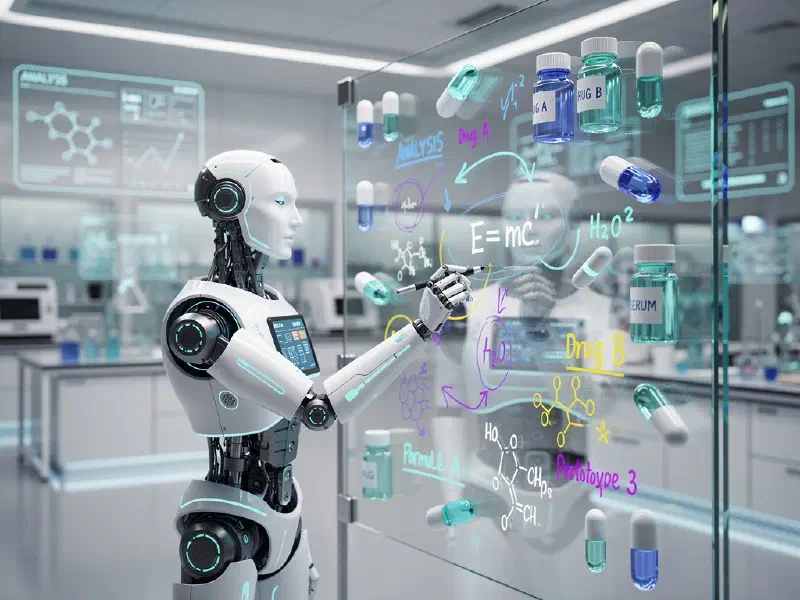
Artificial Intelligence (AI) and machine learning (ML) are revolutionizing drug discovery by analyzing vast datasets to identify novel drug candidates, predict drug responses, and repurpose existing drugs for new therapeutic uses. This section highlights groundbreaking discoveries where AI-driven approaches have accelerated drug development timelines, reduced reliance on animal testing, and provided actionable insights for treating complex diseases such as COVID-19, idiopathic pulmonary fibrosis, and neurodegenerative disorders.
Credit: Mistral
AI-Powered Drug Repurposing for COVID-19 #
The JAK inhibitor baricitinib, originally approved for rheumatoid arthritis, was identified as a potential COVID-19 therapy through an AI-driven in silico NAM that predicted its ability to block SARS-CoV-2 infection and modulate cytokine signaling. Subsequent clinical trials confirmed these predictions, showing that the drug significantly reduced mortality and improved outcomes in hospitalized patients when added to standard care. This success demonstrated the profound power of AI-driven drug repurposing for rapid pandemic response.1
AI-Designed Novel Drug Candidate for Idiopathic Pulmonary Fibrosis #
Insilico Medicine’s AI platform designed a novel drug candidate for idiopathic pulmonary fibrosis in just 18 months by integrating multimodal omics data with deep generative models and graph networks. The candidate successfully advanced to Phase II clinical trials, providing a clear real-world example of AI’s ability to compress traditional drug discovery timelines. This methodology significantly reduced reliance on animal testing while shortening the overall development pipeline.2
Topiramate for Inflammatory Bowel Disease (IBD) #
Researchers utilized transcriptomic reversal scoring and network pharmacology to identify topiramate as a viable candidate for IBD by predicting its capacity to reverse disease-specific expression profiles. While further preclinical and clinical studies are currently ongoing to confirm its efficacy in large-scale human populations, the discovery phase highlights the potential for AI-driven repurposing to address complex inflammatory diseases. This approach offers a data-driven path toward new treatments for chronic conditions.3
Drug Repurposing for Neurodegenerative Disorders #
High-throughput screening identified specific compounds capable of disrupting 14-3-3 protein interactions, which represents a promising therapeutic avenue for Amyotrophic Lateral Sclerosis (ALS). AI integration is currently overcoming the volume and complexity limitations of conventional screening, allowing for more efficient validation of these bio-interactions. These advancements provide new hope for neurodegenerative diseases that currently have significant unmet medical needs.4 5 6
CoreFinder: AI-Driven Discovery of Biosynthetic Gene Clusters #
The CoreFinder system, a transformer-based protein language model, was used to predict biosynthetic gene cluster (BGC) functions in fungi, leading to the discovery of novel clusters. These findings were validated through in vitro fermentation and LC-MS analysis, proving that AI can drive valid scientific discoveries independently of traditional experimental paradigms. The impact of this work is the unlocking of entirely new biosynthetic pathways for future pharmaceutical advancement.7
Disrupting TSLP Signaling as a Treatment for Atopic Diseases #
Scientists identified putative small molecule inhibitors designed to disrupt the interactions between TSLP and its receptor to treat atopic conditions. The efficacy of these molecules was demonstrated in human cell assays, providing a novel and efficient treatment option for diseases like atopic dermatitis and asthma. This discovery provides a human-relevant alternative to traditional animal models specifically for drug discovery in inflammatory skin diseases.8
Drug Failure Reduction through AI and Organoids #
Conventional drug discovery currently faces a 90% failure rate in human trials, primarily due to insufficient efficacy and unanticipated toxicity, with drug-induced liver injury alone causing over 20% of these failures when traditional animal testing proves inadequate. To address this, the University of Michigan and Los Alamos National Laboratory are collaborating on a new supercomputing and AI research center focused on accelerating high-impact research for the public good. By integrating human liver organoids with advanced experimental and computational technologies, this initiative aims to revolutionize the safety evaluation process, improve the accuracy of drug development, and significantly reduce clinical trial failure rates.9
References #
-
Eberle C, Can New Approach Methodologies De-Risk Drug Development?, Charles River Laboratories Discovery, 2025
Discusses how NAMs, including AI-driven toxicity screening and patient-derived organoids, can reduce reliance on animal models and streamline preclinical drug development. ↩︎ -
Ripa JD, Ali S, Field M, et al., From AI-Assisted In Silico Computational Design to Preclinical In Vivo Models: A Multi-Platform Approach to Small Molecule Anti-IBD Drug Discovery, Pharmaceuticals, 2025
Details a multi-platform approach integrating AI-assisted in silico design with preclinical in vivo models to accelerate small molecule drug discovery for inflammatory bowel disease. ↩︎ -
Hussain MS, Mir PA, Kumar N, et al., From Lab to Clinic: Success Stories of Repurposed Drugs in Treating Major Diseases, Advances in Pharmacology and Pharmaceutical Sciences, 2025
Highlights successful case studies of drug repurposing, demonstrating how computational and transcriptomic approaches can identify new therapeutic uses for existing drugs in major diseases. ↩︎ -
Oxford Global, AI-driven High Throughput Screening for Targeted Drug Discovery, Oxford Global, 2024
Explores how AI-driven high-throughput screening utilizes sophisticated algorithms to enhance data processing and interpretation, leading to more efficient targeted drug discovery. ↩︎ -
Greiner Bio-One, How AI Contributes to make High-Throughput Screening more Efficient, GBO Focus Blog, 2023
Discusses how AI and machine learning are transforming high-throughput screening paradigms by enabling iterative screening and foundation models to maximize assay information-content and efficiency. ↩︎ -
Barnes K, NAMs: an exciting era for drug discovery, BioTechniques, 2025
Highlights how new approach methodologies are addressing the gaps in drug discovery studies and creating more human-relevant approaches. ↩︎ -
Kang Z, Zhang H, Liang C, et al., Deciphering Biosynthetic Gene Clusters with a Context-aware Protein Language Model, bioRxiv, 2025
Introduces CoreFinder, a transformer-based protein language model used to predict biosynthetic gene cluster functions in fungi, unlocking new biosynthetic pathways for pharmaceutical advancement. ↩︎ -
Adhikary PP, et al., Disrupting TSLP–TSLP receptor interactions via putative small molecule inhibitors yields a novel and efficient treatment option for atopic diseases, EMBO Molecular Medicine, 2024
Reports the development of small-molecule TSLP receptor inhibitors using virtual screening, providing a novel and efficient human-relevant treatment option for atopic diseases like dermatitis and asthma. ↩︎ -
Barnes K, Reducing drug failures with AI, human liver organoids, University of Michigan Record, 2026
Details a collaboration using human liver organoids and predictive AI to evaluate drug toxicity, aiming to reduce the 90% clinical trial failure rate and replace traditional animal testing. ↩︎