
High Throughput Methods #
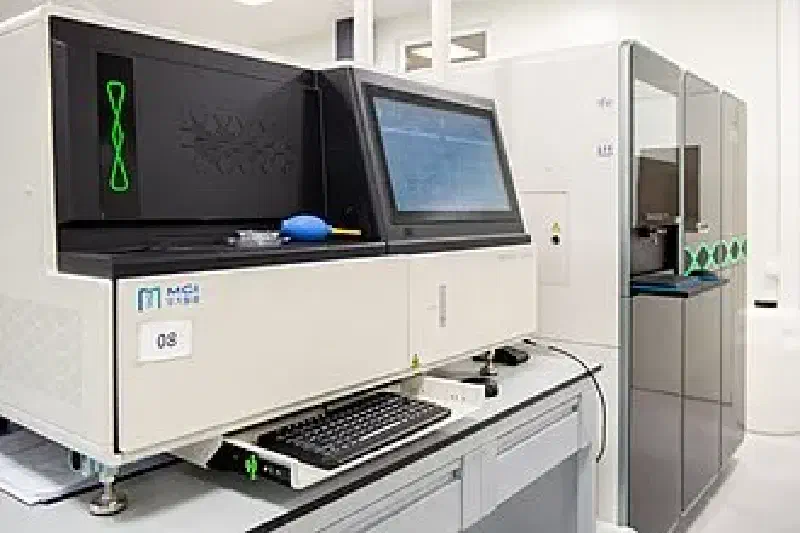
utilizing DNBSEQ technology.
Credit: RPSkokie, CC BY-SA 4.0
High-throughput technologies such as CRISPR screens, single-cell RNA sequencing, and multi-omics integration enable rapid identification and validation of drug targets, disease mechanisms, and toxicity pathways. This section highlights how omics-based NAM are reshaping mechanistic understanding and accelerating the discovery of novel therapies for diseases with high unmet medical needs.
Tox21 Consortium: High-Throughput Chemical Screening #
The Tox21 federal collaboration uses robotic high-throughput screening to evaluate thousands of chemicals simultaneously, leading to the development of an 18-assay battery for the estrogen receptor pathway. The EPA formally accepted this computational model as an alternative to traditional rodent assays for identifying endocrine disruptors. This marked the first regulatory prioritization of robotically derived molecular data over animal testing.1 2 3
Multi-Omics Integration for Toxicity Pathways #
Integrative NAM combining genomics, transcriptomics, proteomics, and metabolomics have revealed novel oxidative stress and mitochondrial dysfunction signatures. These models successfully distinguished adaptive from adverse responses and generated candidate biomarkers for early detection. This has reshaped the mechanistic understanding of chemical toxicity by moving beyond simple observational data.4 5 6 7
CRISPR Screens for Drug Target Validation #
CRISPR/Cas9 gene editing and single-cell RNA sequencing enabled the rapid identification and validation of drug targets for cancer and neurodegenerative diseases. This link between gene perturbations and therapeutic efficacy was validated across multiple cell lines, accelerating the discovery of novel treatments. Consequently, reliance on animal models for target validation has been significantly reduced.8 9 10 5
AOP-Linked In Vitro Screens for Seizure Liability #
A government-industry collaboration mapped mechanisms leading to drug-induced seizures using adverse outcome pathways and in vitro assays. The project identified 27 biological target families and developed over 100 assay endpoints for more accurate risk assessment. This mechanism-focused screening replaces animal models that historically failed to predict drug-induced seizures.11 12 13
References #
-
National Institute of Environmental Health Sciences (NIEHS), Tox21: Chemical testing in the 21st century, NIEHS/NIH, 2017
Outlines the Tox21 program’s strategic roadmap for chemical testing, emphasizing high-throughput screening and computational toxicology to assess health risks. ↩︎ -
Tox21 Program, United States Federal Government TOX21 Collaboration, Tox21.gov, 2023
Provides a comprehensive fact sheet detailing the collaborative efforts of U.S. federal agencies to evaluate the toxicity of thousands of chemicals using high-throughput robotic screening. ↩︎ -
Tox21 Program, About Tox21, Tox21.gov, 2024
Details the mission and overview of the Tox21 collaboration, explaining its role in developing new methods to rapidly test chemicals for potential health effects. ↩︎ -
Shi C, et al., Multi-omics integration analysis: Tools and applications in environmental toxicology, Environmental Pollution, 2024
Reviews the tools and applications of multi-omics integration in environmental toxicology, highlighting how these methods reveal novel oxidative stress and mitochondrial dysfunction signatures. ↩︎ -
Fu C, Chen Q, et al., The future of pharmaceuticals: Artificial intelligence in drug discovery and development, Journal of Pharmaceutical Analysis, 2025
Discusses the integration of AI and multi-omics in pharmaceutical development, emphasizing how these technologies are reshaping the mechanistic understanding of drug toxicity and efficacy. ↩︎ ↩︎ -
Ankli PP, Parween S, Béatrice B, et al., Skin Sensitisation Case Study: Comparison of Defined Approaches including OECD 497 Guidance, bioRxiv, 2024
Presents a case study comparing defined approaches for skin sensitization, demonstrating the practical application of OECD TG 497 guidance and multi-omics data in hazard identification. ↩︎ -
Canzler S, et al., Prospects and challenges of multi-omics data integration in toxicology, Archives of Toxicology, 2020
Explores the prospects and challenges of integrating multi-omics data in toxicology, showing how these models distinguish adaptive from adverse responses and generate candidate biomarkers. ↩︎ -
Charles River Laboratories, CRISPR Cas9 Gene Editing, Charles River, 2024
Details the application of CRISPR/Cas9 gene editing services for high-throughput screening and target validation, reducing the reliance on animal models in early drug discovery. ↩︎ -
Abdul-Hussin IF, CRISPR-Cas9 in Functional Genomics: Implications for Target Validation in Precision Oncology, Trends in Pharmaceutical Biotechnology, 2025
Reviews the application of CRISPR-based platforms in functional genomics, highlighting their critical role in rapid target validation for precision oncology and neurodegenerative diseases. ↩︎ -
Biocompare Editorial, Target Validation with CRISPR, Biocompare, 2022
Discusses the utility of CRISPR screens in validating drug targets across multiple cell lines, accelerating the discovery of novel treatments while minimizing animal use. ↩︎ -
Behl M, Karmaus A, Rao M, et al., De-risking seizure liability: integrating adverse outcome pathways (AOPs), new approach methodologies (NAMs) and in silico approaches while highlighting knowledge gaps, Toxicological Sciences, 2025
Details a government-industry collaboration that mapped mechanisms leading to drug-induced seizures using AOPs and in vitro assays, identifying 27 biological target families for more accurate risk assessment. ↩︎ -
Charles River Laboratories, Can New Approach Methodologies De-Risk Drug Development?, Charles River Eureka, 2024
Explores how NAMs, including mechanism-focused in vitro screens, can de-risk drug development by replacing animal models that historically failed to predict adverse effects like seizures. ↩︎ -
NC3Rs, iPSC derived cardiomyocytes for cardiac toxicity assessment, NC3Rs, 2021
Highlights the use of human iPSC-derived cardiomyocytes and other high-throughput in vitro assays to replace animal-derived primary cells for toxicity screening and hazard identification. ↩︎