
Canada’s Opportunity to Lead in Animal-Free Science #
Published in The Hill Times, April 2026, this campaign highlights the urgent need for Canada to adopt New Approach Methodologies (NAMs)—human-based research methods that are faster, cheaper, and more reliable than animal testing.
1. Infographic: “Would you trust animal tests to predict human health?” #
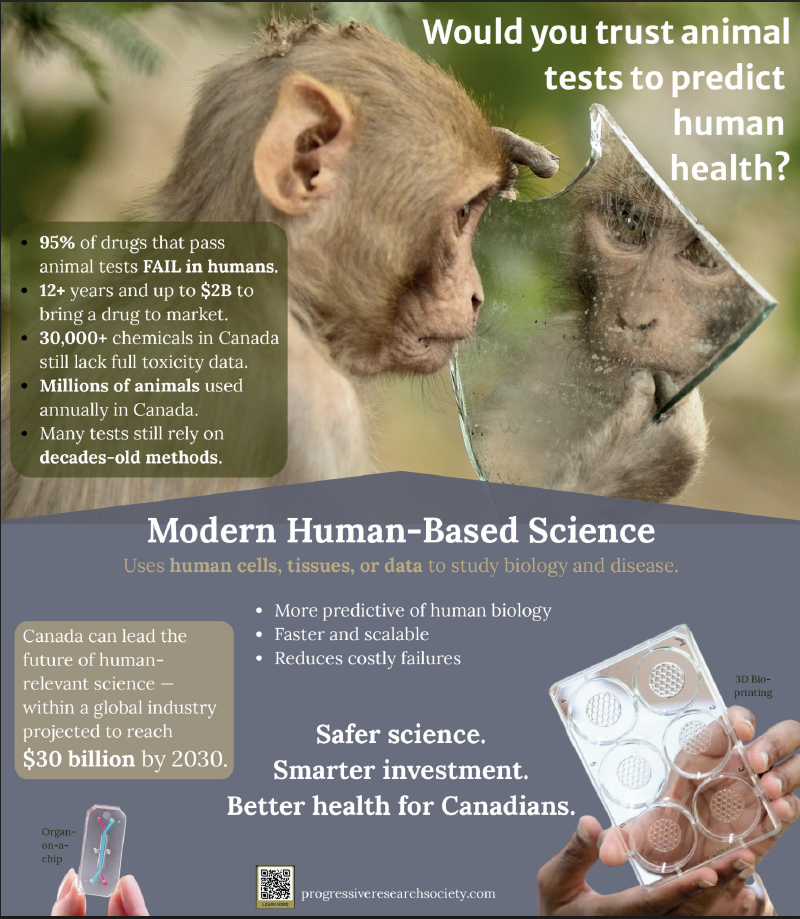
View original image
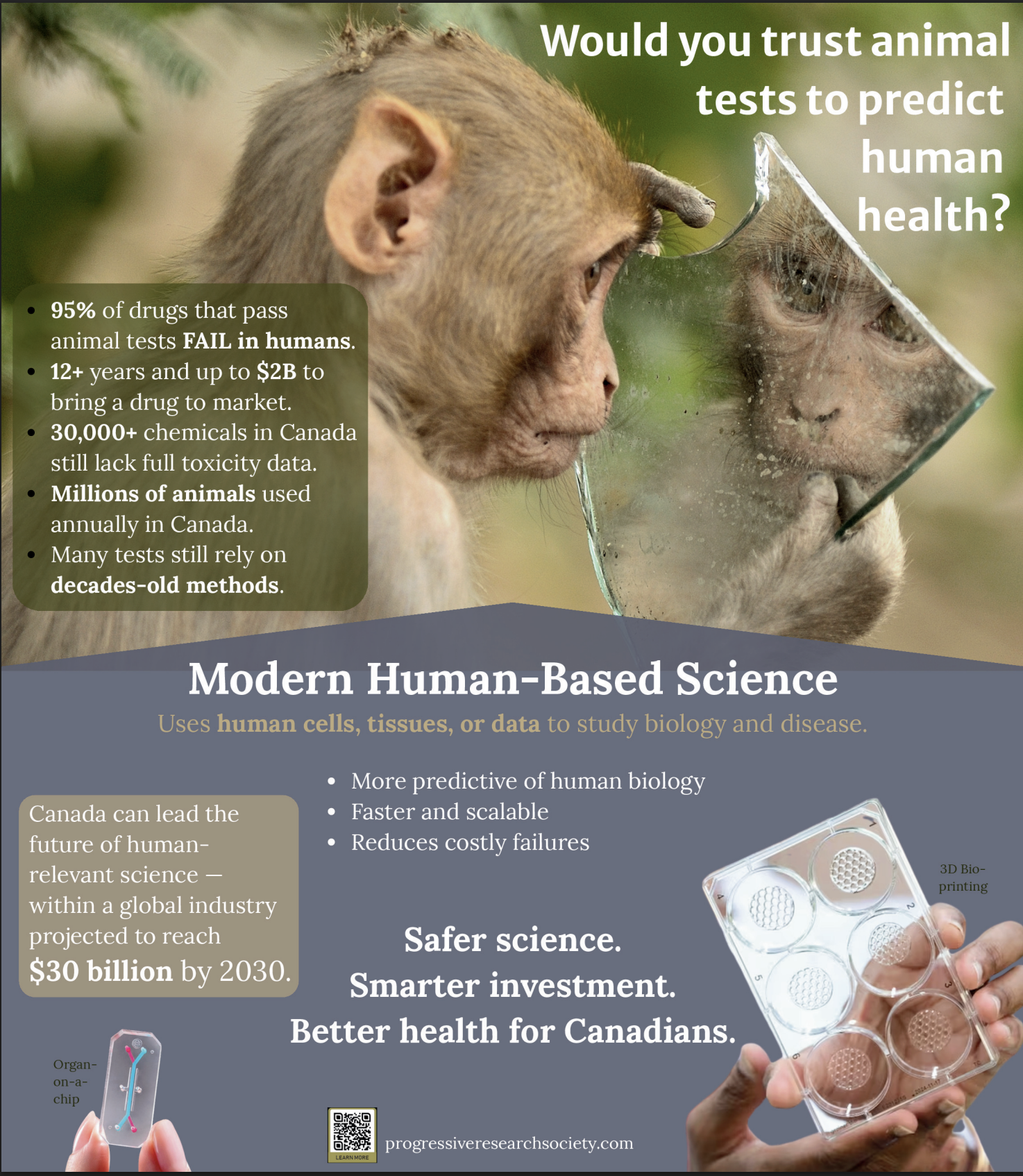
Key Stats:
- 95% of drugs that pass animal tests fail in humans.
- 12+ years and up to $2B to bring a drug to market.
- 30,000+ chemicals in Canada still lack full toxicity data.
- Millions of animals used annually in Canada.
- Modern Human-Based Science:
- Uses human cells, tissues, or data to study biology and disease.
- More predictive, faster, scalable, and reduces costly failures.
- Canada’s opportunity: Lead in a $30 billion global industry by 2030.
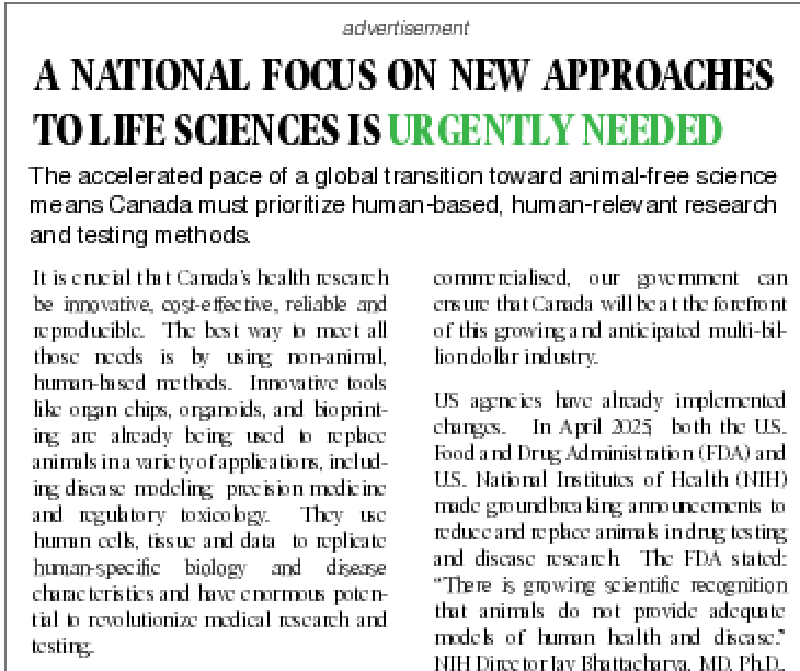
2. Hill Times Ad: “A National Focus on New Approaches to Life Sciences Is Urgently Needed” #
View original pdf
Key Points: #
- 90% of drugs tested on animals fail in humans, wasting resources and delaying cures.
- Three actionable steps for Canada:
- End the federal requirement for animal drug testing.
- Fund a national centre for NAMs (using part of the $552M research funding).
- Direct CIHR/NSERC to transition funding toward non-animal approaches.
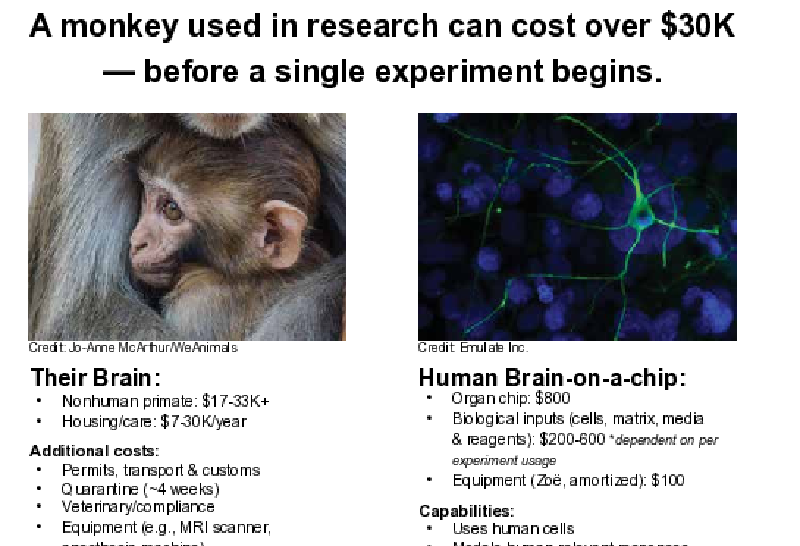
3. Hill Times Ad: “A monkey used in research can cost over $30K” #
View original pdf
Key Points: #
Cost comparison of experiment done on monkey vs brain-on-a-chip in $1K ($1000)
| Item | Non-human primate | Brain-on-a-chip |
|---|---|---|
| The Brain | $17-33K | $0.8K |
| Maintenance | $7-30K/year | $0 |
| Biological Inputs | NA | $2-6K |
| Additional costs | permit,transport,etc | none |
| Total | $24–63K+ first year | $1.5K |
Brain-on-a-chip process is over $60 thousand dollars less than non-human primate research in the first year along. The results from NAM technology are
- human-relevant (unlike non-human primate)
- faster, scalable, and more accurate (than non-human primate)
- safer and sustainable (compared to non-human primate results)
Finally, the Canadian government has funded a new primate research centre at Laval University for $42 million, while the allocation for a National Centre for Alternatives is exactly $0!
PNARS Editorial Note: Why is Canada not funding New Approach Methodologies? This technology is cheaper, faster, more ethical. Furthermore it is more scalable meaning the technology can easily expand and adapt to meet research demands without proportional increases in cost, time, or complexity. NAM allow researchers to run more experiments, get results faster, lower costs, while improving accuracy compared to animal experimentation.