
Glossary #
Credit: Mistral
NAM Terminology #
A curated list of key terms with supporting links related to New Approach Methodologies (NAM) in toxicology, safety assessment, and related fields. Each term includes a brief definition and a link for further reading.
| Term | Definition | Resource |
|---|---|---|
| Adverse Outcome Pathway (AOP) | A conceptual framework that describes the sequential biological events leading to an adverse effect, linking a molecular initiating event to an adverse outcome. | Link |
| Alternative Methods | Approaches that replace, reduce, or refine the use of animals in testing (e.g., toxicology), including in vitro, in silico, and in chemico methods. | Link |
| Computational Toxicology | The use of computer-based models, algorithmic frameworks, and simulations to predict chemical toxicity and clarify biological mechanisms of action. | Link |
| CRISPR (Clustered Regularly Interspaced Short Palindromic Repeats) | A precision gene-editing technology used in modern safety assessment to establish direct causal links within Molecular Initiating Events (MIEs) and Adverse Outcome Pathways (AOPs). Rather than relying on animal models, researchers use CRISPR-Cas9/Cas12 systems to knock out, knock down, or overexpress specific human genes in vitro. This allows for high-throughput screening of cellular vulnerabilities, validating exactly which human proteins or genomic pathways are targeted by a chemical toxicant. | link |
| Defined Approaches (DA) | A regulatory assessment framework consisting of a fixed data interpretation procedure applied to a predefined set of information sources, removing subjective expert judgment. | Link |
| Exposure Assessment | The process of estimating or measuring the magnitude, frequency, and duration of exposure to a chemical or physical agent within a human or ecological population. | Link |
| High-Throughput Screening (HTS) | The use of automated robotics, liquid handling, and miniaturized microfluidic assays to rapidly test thousands of chemical substances against biological targets to generate massive, human-relevant data profiles using high-capacity computational analysis. | Link |
| In Chemico | Abiotic, non-cellular chemical assays used to measure direct chemical reactivity or physical-chemical properties (e.g., protein binding potential). | Link |
| In Silico | Advanced computational models, simulations, or structural algorithms—such as QSARs, machine learning, or molecular docking—used to predict bioactivity. | Link |
| In Vitro | Biological assays conducted outside of a living organism, utilizing cultured cells, tissue slices, or isolated human organs in a highly controlled environment. | Link |
| Integrated Approaches to Testing and Assessment (IATA) | A flexible, science-based approach combining multiple data sources (e.g., in silico, in vitro, exposure profiles) to evaluate safety, allowing expert judgment to guide weight of evidence. | Link |
| Key Event (KE) | An intermediate, measurable biological change within an Adverse Outcome Pathway that is essential for the progression toward an adverse health effect. | Link |
| Mechanistic Toxicology | The scientific study of how specific chemical substances interact with cellular systems at the molecular or physiological level to induce toxic outcomes. | Link |
| Microphysiological Systems (MPS) | Bioengineered microfluidic devices that mimic the complex structural, mechanical, and functional architecture of human organ systems (“organs-on-chips”). | Link |
| Molecular Initiating Event (MIE) | The initial site of direct, causal interaction between a chemical substance and a biological target (e.g., cell receptor binding) that triggers an Adverse Outcome Pathway. | Link |
| New Approach Methodologies (NAM) | A comprehensive term encompassing non-animal testing strategies, including computational tools, cellular assays, and biochemical technologies used for safety evaluation. | Link |
| Omics Technologies | High-throughput molecular profiles that evaluate comprehensive shifts within biological systems, spanning genomics, transcriptomics, proteomics, and metabolomics. | Link |
| Physiologically Based Pharmacokinetic (PBPK) Modeling | Mathematical modeling frameworks that map the absorption, distribution, metabolism, and excretion (ADME) profiles of chemical compounds through actual physiological compartments. | Link |
| Quantitative Structure-Activity Relationship (QSAR) | Mathematical and statistical predictive models that relate a chemical’s explicit molecular structure to its specific biological activity or chemical toxicity. | Link |
| Read-Across | A computational technique where endpoint data from a known, well-characterized “source” chemical is used to predict the toxicity profile of a structurally similar “target” chemical. | Link |
| Risk Assessment | The quantitative or qualitative evaluation determining the likelihood and severity of adverse health or ecological effects resulting from real-world exposure to chemical hazards. | Link |
| Safety Assessment via NAM | The practical deployment of non-animal predictive data to define clinical safety margins, product efficacy, or chemical hazard classifications for regulatory clearance. | Link |
| Toxicokinetics | The study of how a chemical is absorbed, distributed, metabolized, and excreted (ADME) over time. In modern NAM, traditional animal-based measurements are entirely replaced by coupling human-derived cell assays (e.g., in vitro hepatic clearance) with advanced computational modeling (e.g., in vitro-to-in vivo extrapolation, or IVIVE) to predict chemical behavior and safe exposure levels inside a virtual human system. | Link |
| Virtual Tissue Models | Multi-scale computational computer models that simulate how chemical perturbations alter human organ development, tissue morphology, and homeostatic cellular functions. | Link |
| Weight of Evidence (WoE) | A structured framework to qualitatively or quantitatively assess the cumulative alignment, scientific robustness, and logical consistency of multiple distinct data streams. | Link |
AI Terminology Relevant to NAM #
The diagram below illustrates exactly how specific computational tools provide the front end of the drug discovery and toxicity pipeline by processing massive chemical and molecular data repositories.
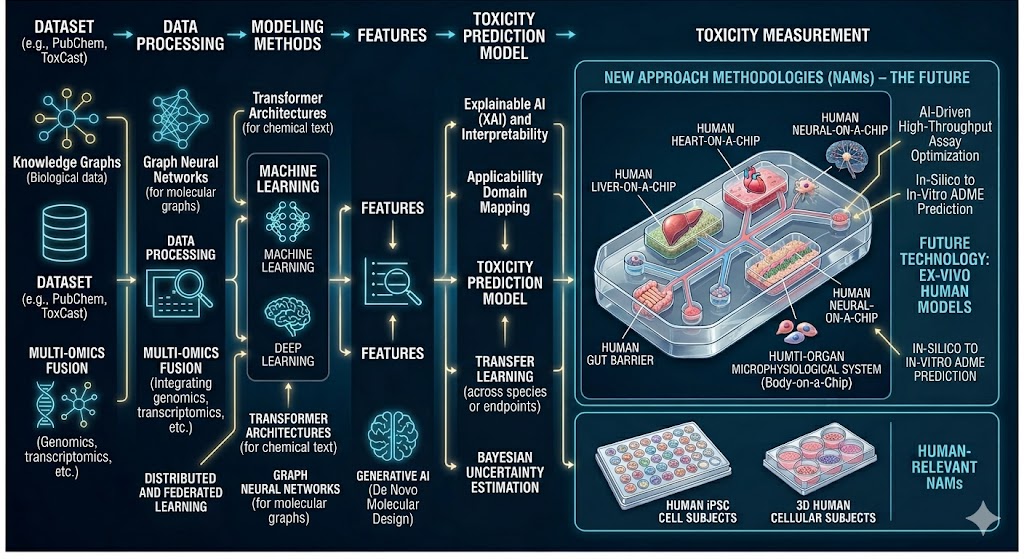
(Click image for larger view)
Credit: Gemini
| Term | Specific NAM-Context Definition | Resource |
|---|---|---|
| Active Learning (AL) | An iterative machine learning strategy where the algorithm selects the most informative uncharacterized chemicals for experimental in vitro testing to optimize predictive power with minimal assays. | Link |
| Applicability Domain (AD) | The structural, physico-chemical, and response space defined by the training set of a computational model, establishing the boundaries within which a toxicity prediction is reliable. | Link |
| Deep Learning (DL) | A subset of machine learning using multi-layered neural networks to automatically extract complex features from raw biochemical data, such as predicting organ-level toxicity from high-content cell imaging. | Link |
| Explainable AI (XAI) | Machine learning methodologies designed to make the internal algorithmic decision-making process transparent, crucial for verifying the biological plausibility of a predicted toxic mechanism for regulatory clearance. | Link |
| Features | Measurable variables and characteristics used as inputs for a model to make predictions. | Link |
| Generative AI | AI frameworks (e.g., variational autoencoders) used to generate entirely new chemical structures (e.g., De Novo Molecular Design) with optimized, target-specific therapeutic properties while intentionally designing out structural alerts for toxicity. | Link |
| Graph Neural Networks (GNN) | Deep learning architectures that operate directly on graphs, mapping chemical structures as networks of atoms (nodes) and bonds (edges) to predict molecular reactivity and target binding without manual feature descriptors. | Link |
| Knowledge Graph (KG) | A structured database network representing complex biological relationships (e.g., linking genes, proteins, diseases, and chemical stressors) to discover hidden mechanistic pathways and assist in AOP generation. | Link |
| Machine Learning (ML) | Algorithms that detect statistical patterns in extensive toxicology datasets (e.g., ToxCast) to classify compounds as hazardous or safe based on historic in vitro profiles without explicit biochemical programming. | Link |
| Large Language Models (LLMs) in Bio | Domain-specific foundational models trained on scientific literature and chemical structural languages (like SMILES strings) to synthesize data, extract toxicity endpoints, or predict molecular behavior. | Link |
| Multi-Omics Integration | Computational frameworks designed to align and process parallel high-throughput datasets (genomics, transcriptomics, metabolomics) to map an organism’s holistic cellular response to a xenobiotic. | Link |
| SMILES (Simplified Molecular Input Line Entry System) | A linear ASCII string notation used to describe chemical structures, serving as the primary text-based input format for chemical datasets parsed by machine learning models. | Link |
| Transfer Learning | An ML technique where a model trained on a massive, general chemical dataset applies its learned structural knowledge to a smaller, highly specific target toxicity dataset where data is scarce. | Link |