
Asbestos Testing Emerging Trends #
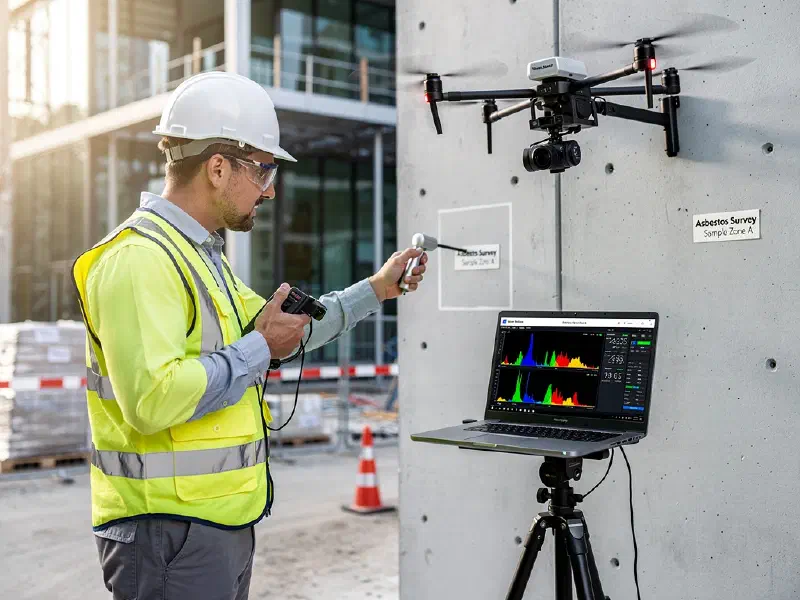
while a drone equipped with sensors surveys the building,
demonstrating the integration of AI, spectroscopy, and real-time
data analysis in asbestos identification.
Credit: Mistral
Introduction #
Asbestos, a group of naturally occurring fibrous minerals, has been widely used in construction and industrial applications due to its durability, fire resistance, and insulating properties. However, its fibrous nature poses severe health risks, including lung cancer, mesothelioma, and asbestosis, when inhaled.
An often overlooked area is that of Secondary Asbestos Exposure (SAE) which happens when individuals come into contact with asbestos fibers carried home on the clothing, hair, or equipment of someone directly exposed, often leading to inhalation or ingestion of the fibers. Family members, particularly women and children, are most at risk. Research suggests up to 30% of mesothelioma cases in the U.S. may be linked to secondary exposure. SAE is a matter of serious concern and legal groups such as Lanier Law Firm devote specialized attention to it: Secondary Asbestos Exposure: The Hidden Risk to Families.
Traditional methods for detecting and identifying asbestos, such as polarized light microscopy (PLM) and transmission electron microscopy (TEM), have been the gold standard for decades. These methods, while effective, are often time-consuming, costly, and require specialized laboratory equipment and expertise.
In recent years, the scientific and regulatory communities have increasingly turned their attention to New Approach Methodologies (NAM) innovative, non-animal testing strategies that leverage advances in technology, data science, and analytical chemistry. NAM encompass a broad range of methods, including in silico (computational), in chemico(chemical reaction), in vitro (organic modeling) approaches, as well as emerging technologies like machine learning, portable spectroscopy, and artificial intelligence (AI). These methodologies aim to provide faster, more cost-effective, and often more accessible means of detecting and assessing asbestos-containing material (ACM) while maintaining or improving accuracy and reliability.
This article explores the current landscape of asbestos testing, with a focus on the role of NAM in modernizing detection and analysis. It highlights recent advancements, their potential benefits, and the challenges associated with their adoption.
Traditional Asbestos Testing Methods #
Historically, asbestos testing has relied on well-established methodologies such as PLM and TEM. PLM is commonly used for bulk sample analysis, while TEM is employed for more detailed characterization, particularly in airborne fiber analysis. These methods are highly regulated and widely accepted by agencies such as the U.S. National Institute for Occupational Safety and Health (NIOSH) and the Occupational Safety and Health Administration (OSHA). For example, NIOSH Method 9002 is a standardized procedure for identifying asbestos in bulk samples, while NIOSH Method 7400 is used for counting airborne fibers using phase-contrast microscopy (PCM)1.
While these traditional methods are robust and well-validated, they have limitations. PLM, for instance, cannot distinguish between asbestos and non-asbestos fibers with absolute certainty, and TEM, though more precise, is expensive and requires highly trained personnel. Additionally, these methods often involve destructive sampling, which can be impractical for large-scale or on-site assessments.
The Rise of New Approach Methodologies #
NAM represent a paradigm shift in chemical hazard and risk assessment. These methodologies are defined as any technology, approach, or combination thereof that can provide information on chemical hazards without relying on animal testing. In the context of asbestos, NAM include advanced analytical techniques, computational models, and data-driven approaches that complement or potentially replace traditional methods.
The adoption of NAM is driven by several factors:
- Efficiency: NAM can reduce the time and cost associated with asbestos detection and analysis.
- Accessibility: Portable and handheld devices enable on-site or real-time testing, reducing the need for laboratory-based analysis.
- Sustainability: Non-destructive and non-invasive methods minimize the environmental and structural impact of testing.
- Accuracy: Some NAM, particularly those leveraging AI and machine learning, have the potential to exceed the accuracy of human analysis by integrating multiple data sources.
Recent Advances in NAM for Asbestos Detection #
Scanning Electron Microscopy (SEM) as a Viable Alternative #
One of the most promising developments in asbestos detection is the use of scanning electron microscopy (SEM) as a cost-effective and convenient alternative to TEM. Researchers at the National Institute of Standards and Technology (NIST) have demonstrated that SEM can achieve results comparable to TEM for asbestos identification and classification. SEM is particularly advantageous due to its lower cost and greater accessibility, making it a practical option for widespread use in asbestos remediation projects. This advancement could significantly reduce the financial burden of asbestos testing, which is estimated to cost billions annually in the USA2.
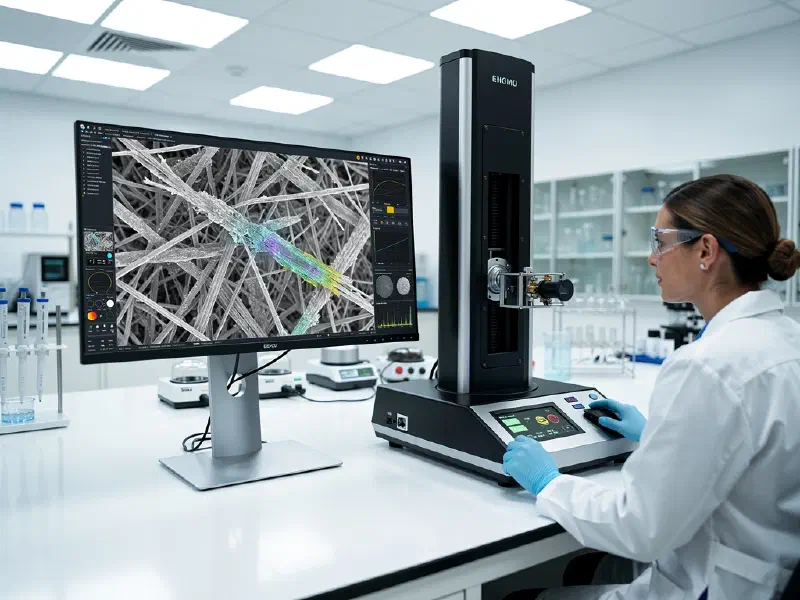
TEM for identifying and classifying asbestos fibers in laboratory settings.
Credit: Mistral
Machine Learning and Short-Wave Infrared (SWIR) Spectroscopy #
A groundbreaking study published in Sustainability (2025) by researchers at Sapienza University of Rome highlights the potential of short-wave infrared (SWIR) spectroscopy combined with machine learning for asbestos detection. This method offers a noninvasive, accurate, and sustainable approach to identifying hazardous mineral fibers, including asbestos, in various materials. By leveraging machine learning algorithms, the technique can analyze spectral data to distinguish between different types of fibers with high precision. This approach is particularly valuable for on-site applications, where traditional laboratory-based methods may be impractical3.
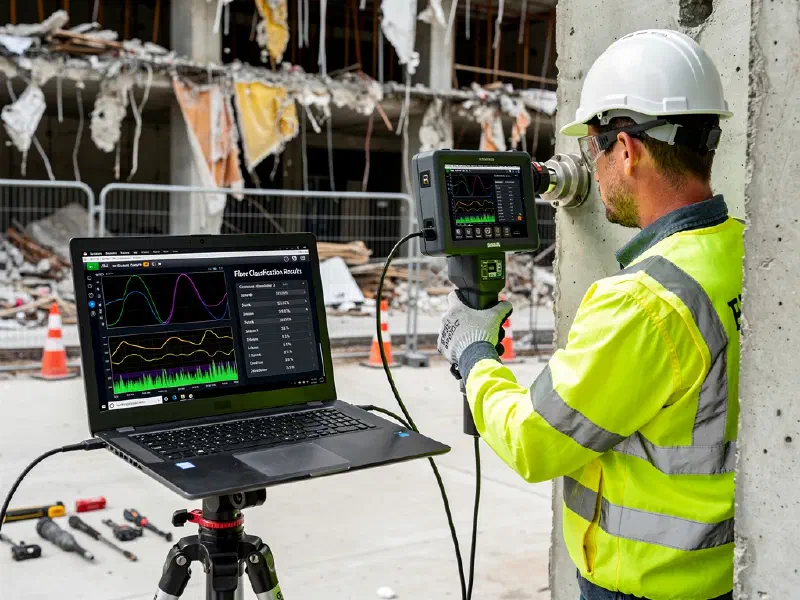
noninvasive, accurate detection and classification of asbestos fibers on-site.
Credit: Mistral
AI, Drones, and Multi-Modal Detection Systems #
The integration of artificial intelligence (AI), drones, and multi-modal detection systems is revolutionizing asbestos surveying. Modern AI systems are being developed to combine data from multiple sources, such as spectroscopic signatures, microscopy images, thermal patterns, and historical building information. This multi-modal approach enables more accurate and comprehensive identification of ACM, often surpassing the capabilities of human analysts. Drones equipped with these technologies can conduct large-scale surveys of buildings, providing a safer and more efficient means of detecting asbestos in hard-to-reach areas4.

combining spectroscopic, thermal, and visual data for comprehensive building assessments.
Credit: Mistral
Portable Raman Spectroscopy #
Researchers at the Australian National University and other institutions are pioneering the use of portable, handheld Raman spectroscopy devices for asbestos detection. These devices allow for on-site analysis of building materials without the need for destructive sampling, making the process faster, safer, and more sustainable. Raman spectroscopy works by identifying the unique molecular vibrations of asbestos fibers, enabling accurate detection and classification in real time. This technology is particularly useful for preliminary screenings and rapid assessments in renovation or demolition projects5.
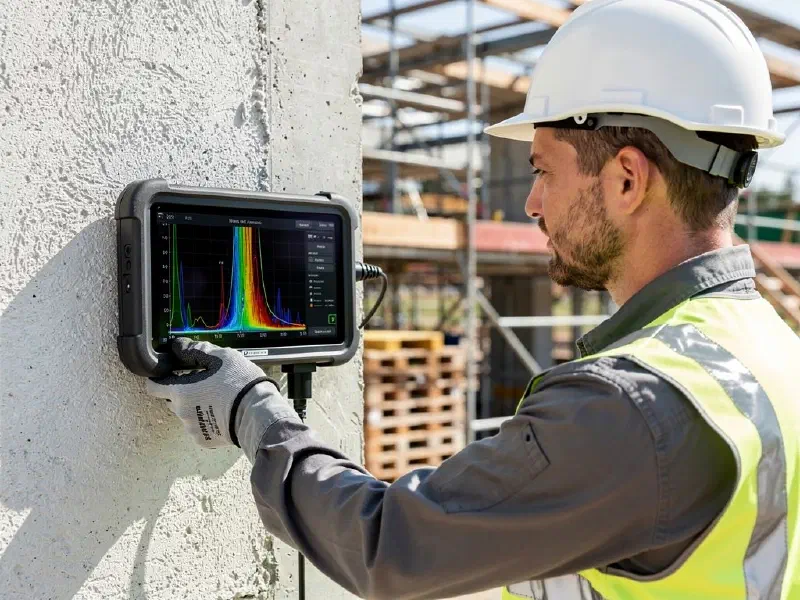
destructive sampling, identifying fiber types through unique molecular vibrations.
Credit: Mistral
Data-Driven Methodologies #
In the United Kingdom, asbestos management organizations have developed data-driven methodologies that use bespoke algorithms to analyze large datasets of asbestos survey information. By applying these algorithms to existing datasets, such as those from asbestos surveys, energy performance certificates, and building registers, these organizations can more accurately identify the location and condition of ACM. This approach not only improves the efficiency of asbestos management but also provides building owners with clear, actionable insights for risk assessment and remediation planning6.

Credit: Mistral
Regulatory and Practical Considerations #
While NAM hold significant promise for modernizing asbestos testing, their adoption faces several challenges. Regulatory agencies, such as the U.S. Environmental Protection Agency (EPA) and Health Canada, have historically relied on traditional methods like TEM and PLM for compliance and risk assessment. The integration of NAM into regulatory frameworks requires extensive validation, standardization, and collaboration between scientists, regulators, and industry stakeholders.
For example, the U.S. Food and Drug Administration (FDA) has recently withdrawn a proposed rule on testing methods for detecting and identifying asbestos in talc-containing cosmetic products, citing the need for further consideration and assessment of public comments. This highlights the complexities of transitioning to new methodologies, particularly in highly regulated sectors where the stakes for public health are high7.
NAM offer significant advantages in terms of speed and cost. Widespread acceptance will require not only technical validation, but also the development of clear guidelines and training programs for professionals in the field.
Future Outlook #
The future of asbestos testing lies in the continued development and integration of NAM into mainstream practices. As technologies such as AI, machine learning, and portable spectroscopy mature, they are likely to play an increasingly important role in asbestos detection and management. These advancements could lead to:
- Improved early detection of asbestos in buildings and materials, reducing exposure risks.
- More efficient and cost-effective remediation projects, particularly in large-scale or remote locations.
- Enhanced regulatory compliance through the use of standardized, validated NAM that meet or exceed the performance of traditional methods.
However, the transition to NAM will require ongoing collaboration between researchers, regulators, and industry professionals to ensure that these new methods are both scientifically robust and practically feasible. The ultimate goal is to create a testing ecosystem that is not only more efficient and sustainable but also more protective of human health.
References #
-
Canada, Employment and Social Development. “Technical guideline to asbestos exposure management programs.” Technical Guideline to Asbestos Exposure Management Programs - Canada.ca.
This guideline outlines traditional methods such as NIOSH Method 9002 for bulk sampling and phase-contrast microscopy for airborne fiber counting, which remain the standard for asbestos testing in Canada. ↩︎ -
Holm J., Mansfield E., “Transmission electron imaging and diffraction of asbestos fibers in a scanning electron microscope.”, Analytical Methods, 2024.
This study addresses the limitations of 35-year-old airborne asbestos clearance protocols that rely exclusively on transmission electron microscopy (TEM), proposing a viable alternative using advanced scanning electron microscopy (SEM). The methodology involves utilizing NIST Asbestos Standard Reference Materials to demonstrate that a conventional SEM, equipped with improved capabilities for spatial resolution, elemental analysis, and electron diffraction, can successfully replicate the identification and quantification functions of TEM. Key findings confirm that characteristic asbestos signatures, specifically the 0.53 nm layer line spacing and other chrysotile diffraction patterns, can be accurately detected and quantified via SEM using various detection methods, establishing it as a comparable and effective substitute for current regulatory TEM-based techniques. Also see NIST Researchers Identify a Cheaper, More Convenient Method to Detect Asbestos. ↩︎ -
Bonifazi G., Bellagamba S., et al., “Short-Wave Infrared Spectroscopy for On-Site Discrimination of Hazardous Mineral Fibers Using Machine Learning Techniques”, Sustainability, 2025.
This study addresses the critical need for rapid, noninvasive, and environmentally sustainable detection of asbestos to protect public health and ensure safety, proposing a short-wave infrared (SWIR) spectroscopy combined with machine learning as a superior alternative to traditional laboratory methods. The researchers evaluated five chemometrics classifiers—PLS-DA, PCA-DA, PCA-KNN, CART, and ECOC SVM—on diverse samples including various asbestos types, contaminated soils, and cement. Results demonstrated that CART and ECOC SVM achieved perfect discrimination performance (RecallM and AccuracyM of 1.00), significantly outperforming PLS-DA and PCA-DA, while PCA-KNN also showed high efficacy; these findings validate the proposed approach as a highly accurate, low-waste solution that aligns with UN Sustainable Development Goals 3 and 12. Also see Revolutionizing Asbestos Detection: Machine Learning and SWIR Spectroscopy Offer Sustainable Solutions. ↩︎ -
Supernova Asbestos Surveys. “What Advancements Are Being Made in Identifying & Locating Asbestos in Buildings?” Supernova Group, 7 Mar. 2025. Asbestos Detection Tech Advances UK.
This article discusses the use of AI, drones, and multi-modal detection systems to improve the accuracy and efficiency of asbestos surveys in buildings, combining data from spectroscopy, microscopy, and thermal imaging. ↩︎ -
“Advancements in Asbestos Detection and Removal Technologies.” Unyse, 2025. Advancements in Asbestos Detection and Removal Technologies.
Highlights the development of portable, handheld Raman spectroscopy devices for on-site asbestos detection, drone technology, AI analysis, enabling real-time processes without destructive sampling. Disposal solutions including robotic removal and encapsulation are also presented. ↩︎ -
“Why It’s Time for a New National Asbestos Strategy.” British Safety Council, 2025. Why it’s time for a new national asbestos strategy.
Describes a data-driven methodology using bespoke algorithms to analyze large datasets of asbestos survey information, improving the accuracy and efficiency of asbestos identification and management.* ↩︎ -
Federal Register. “Testing Methods for Detecting and Identifying Asbestos in Talc-Containing Cosmetic Products; Withdrawal.” 28 Nov. 2025. Testing Methods for Detecting and Identifying Asbestos in Talc-Containing Cosmetic Products; Withdrawal.
The FDA withdrew a proposed rule on asbestos testing methods for talc-containing cosmetics, citing the need for further assessment of public comments and highlighting the challenges of transitioning to new testing methodologies.* ↩︎