NAMIFY #
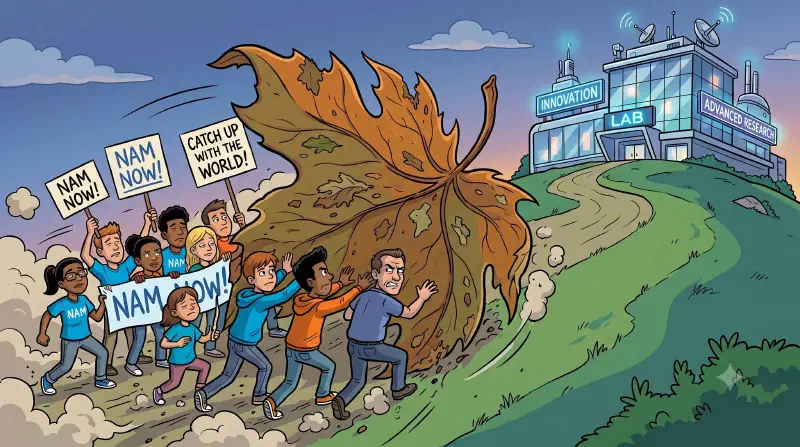
It’s up to you!
Credit: Gemini
This about Canada’s future and your future! This page provides an action-oriented guide for students (as well as guardians, school teachers, professors, and progressive politicians) to lift this country’s bio-science education out of the “dreary desert sand of dead habit” into a new awakening!
Why This Matters to You #
For Students: Canada Is Falling Behind - Don’t Get Left Out #
Right now, Canada is skipping the future of science. While other countries invest millions in New Approach Method (NAM) - modern, ethical, and cutting-edge methods - Canada still teaches students to dissect frogs and cats, as well as rely on outdated animal testing.
NAM isn’t just about ethics. It’s about staying competitive.
- The Netherlands invests €124.5 million to train scientists in NAM.
- The U.S. dedicates $150 million USD to develop alternatives to animal testing.
- Where is Canada? Nowhere.
If you’re studying biology, medicine, or toxicology, you’re being trained for an industry that’s already moving on. Companies like Mimetas, Emulate Bio, and AstraZeneca use organ-on-a-chip and computational toxicology. Will you be ready?
For Parents: Your Child’s Education Is Outdated #
Your kids are growing up in a world where:
- AI and computer models predict drug safety.
- Miniature human organs grown in labs replace animal testing.
- 3D bioprinting creates ethical research alternatives.
But in most Canadian schools, they’re still:
- Cutting up frogs against their will.
- Forced to participate in harming animals.
- Taught using methods that are 50 years out of date.
NAM isn’t just about science - it’s about human rights, career readiness, and global competitiveness.
What Is NAM? #
NAM stands for New Approach Methodologies - modern tools replacing animal testing. Here’s what it includes:
| NAM Type | What It Is | Why It’s Better |
|---|---|---|
| Computational Toxicology | Uses AI and computer models to predict chemical safety. | Saves money, time, and animal lives. |
| Organ-on-a-Chip | Miniature human organs grown in labs for testing. | More accurate than animal testing. |
| In Silico Modeling | Simulates biological processes using software. | Reduces reliance on live animals. |
| 3D Bioprinting | Prints living tissues for research. | Allows for precise, ethical experimentation. |
NAM is already used by top researchers worldwide - but rarely in Canadian classrooms.
Real Stories: Youth Taking Action #
Case Study 1: Windsor-Essex Catholic School Board #
In 2019, this school board banned dissection and replaced it with virtual simulations and synthetic models. Why? Because students demanded it.
“I refused to dissect a frog because it felt wrong. My teacher said I had to, but I stood my ground. Now, no one else has to either.”
- Maria, Grade 11 Student
Case Study 2: University of Toronto’s Organ-on-a-Chip Course #
This graduate-level course teaches students how to engineer miniaturized human organs for research. But it’s only for engineering students - not biology or toxicology majors.
“I wish I had learned this in undergrad. These tools are the future of medicine.”
- Jordan, Biology Student
Case Study 3: Dutch NAM Hub #
The Netherlands invested €124.5 million to create the Centre for Animal-Free Biomedical Translation (CPBT), a national hub training scientists in NAM. (In contrast, Canada caused its only ’national hub’ Canadian Centre for Alternatives to Animal Methods to close through lack of funding.)
The Quick Start Guide: How YOU Can Make a Difference #
For Students: Petition for Change #
- Learn About NAM
- Watch: TED Talk: The Future of Animal-Free Science
- Read: NAM 101 for Students
- Explore: Virtual Labs and Simulations
- Talk to Your Teacher
- Ask: “Why are we still using dissection when modern tools exist?”
- Share: This Letter Template to request alternatives.
- Propose: A guest speaker (e.g., a NAM researcher) or a debate on the topic.
- Start a NAM Club
- Recruit 5+ friends.
- Host screenings of documentaries like “Saving the World’s Animals” (BBC).
- Write to your MP using this template.
- Organize a petition to demand NAM training in your school.
- Advocate Beyond School
- Share on social media: Use #NextGenNAM and tag your school.
- Write for your school newspaper.
- Join a youth network (e.g., NAM Youth Canada).
- Demand Policy Change
- Petition for mandatory computational/NAM training in your major.
- Write to your university president and MP.
For Teachers: Demand Robust Alternatives #
- Advocate for Updated Curricula
- Demand that dissection alternatives are robust and standardized, not just “optional supplements.”
- Push for the integration of computational toxicology and organ-on-a-chip into your department’s courses.
- Bring NAM into Your Classroom
- Use virtual labs and simulations (e.g., Labster).
- Invite NAM researchers to speak to your students.
- Organize a debate on the ethics of animal testing vs. NAM.
- Join the Movement
- Sign the petition to demand federal funding for NAM education.
- Share resources with colleagues (e.g., NAM Toolkit for Teachers).
For Parents: Support Modern Science Education #
- Advocate for Updated Curricula
- Write to your child’s school board and demand digital alternatives to dissection.
- Push for the integration of NAM concepts into science courses.
- Encourage Ethical Choices
- If your child objects to dissection, support their right to opt out without penalty.
- Share resources like this guide with other parents.
- Demand Policy Change
- Write to your MP and provincial education minister to demand NAM funding.
- Support organizations advocating for modern science education (e.g., Vancouver Humane Society).
For Politicians: Create the Future of Canadian Science #
- Establish a Dedicated Federal NAM Funding Body
- Model it after the U.S. NIH Complement-ARIE or Dutch CPBT.
- Allocate $50 million CAD annually for NAM research and education.
- Fund the “Pathways to Alternatives” Budget
- Direct funds to Health Canada’s CEPA implementation to ensure NAM are prioritized.
- Train regulatory scientists in computational toxicology and organ-on-a-chip.
- Reform Academic Granting Councils
- Eliminate bias in CIHR/NSERC peer review toward animal-based research.
- Create dedicated NAM funding streams for early-career researchers.
The Big Picture: Why Canada Must Act Now #
Stay Competitive #
Other countries are investing millions in NAM. If Canada doesn’t catch up:
- Students won’t be prepared for modern careers.
- Researchers will leave for countries with better funding.
- Canada will fall behind in ethical, cutting-edge science.
Lead with Human Rights #
Forcing students to dissect against their beliefs is unethical and unnecessary. NAM offers a humane, accurate, and modern alternative.
Build the Future #
NAM isn’t just about replacing animal testing - it’s about training the next generation of scientists to use the tools of the future.
Your Call to Action #
Canada’s future in science depends on YOU.
- Sign the petition to demand NAM education: [Link]
- Share this guide with 3 friends.
- Write to your MP today: [Template Link]
“The youth of today will shape the science of tomorrow. Let’s make sure it’s ethical, modern, inclusive, and innovative!”