
RAISE #
Credit: Gemini
There are several resources here
- FAQ
- Petition Strategy
- Emails to MPs
- Videos (may take time to load depending on your equipment)
The Table Of Contents is useful for navigating this page.
FAQ #
Canadian Bioscience Education is stuck in the past.
What Can You Do About It?
Q1. Why are Canadian students still dissecting animals in 2026?
Canadian science curricula remain heavily reliant on traditional, animal-based methods due to outdated provincial standards, lack of funding for modern alternatives, and slow adoption of New Approach Methodologies (NAM). While countries like the Netherlands and the US are phasing out dissection in favor of digital simulations, organ-on-a-chip models, and AI-driven tools, Canada’s curriculum revision cycles (often 5–10 years) and underfunded teacher training delay progress. There is also no dedicated federal funding body for NAM integration in education, unlike in the EU or UK.
Q2. How does this compare to other countries?
Canada is falling behind. The Netherlands has banned animal dissection in secondary schools, the US FDA now accepts NAM-based data for drug approvals, Australia runs a national non-animal research service, and the UK invests in national NAM training hubs. In contrast, Canadian universities and high schools still treat dissection as a “rite of passage”, despite evidence that NAM (e.g., virtual labs, 3D modeling) often yield better learning outcomes and align with ethical, cost-effective, and scientifically superior practices.
Q3. Why hasn’t Canada adopted NAM faster?
Three key barriers:
- Funding gaps: Provincial education budgets prioritize existing infrastructure (e.g., animal labs) over NAM tools, which require upfront investment in software, hardware, and teacher training. For example, Ontario’s 2025–26 education funding gap is $1.3 billion, with no earmarked funds for modernizing science labs.
- Regulatory inertia: Health Canada and Environment Canada have no mandatory NAM adoption policies for education, unlike the FDA or EMA, which now require NAM consideration in toxicology and drug development.
- Awareness: Many educators and policymakers are unaware of NAM potential or mistakenly believe animal models are the “gold standard,” despite growing evidence to the contrary.
Q4. What are NAM, and why are they better?
New Approach Methodologies (NAM) are non-animal, human-relevant tools like:
- In silico models (computer simulations of biological processes).
- Organ-on-a-chip (miniature organs that mimic human physiology).
- AI/ML-driven data analysis (predicting toxicity or disease mechanisms).
- Virtual dissection (interactive 3D models of anatomy).
Advantages:
- More accurate: Human-based models better predict human responses than animal tests.
- Ethical: No animal suffering or environmental harm.
- Cost-effective: Reduces long-term costs (e.g., no need for animal facilities).
- Future-proof: Aligns with global industry standards (e.g., pharmaceutical companies now prefer NAM for drug development).
Q5. How does this affect students’ futures?
Students trained in outdated methods risk being unprepared for modern careers in:
- Biotech/pharma: Companies like Moderna and Pfizer use NAM for drug discovery.
- Regulatory science: Agencies (e.g., FDA, EMA) increasingly require NAM data for approvals.
- Academic research: Top journals (e.g., Nature, Science) prioritize human-relevant studies.
Result: Canadian graduates may lack competitive skills, while their peers abroad gain hands-on experience with cutting-edge tools.
Q6. What can students do?
Stand up for your education!
- Demand change: Petition your school/universities to replace dissection with NAM (e.g., virtual labs like BioDigital Human or Visible Body).
- Start a NAM club: Organize workshops, invite speakers, and collaborate with groups at school, university, industry levels.
- Use free NAM tools: Explore open-access platforms like PhysioEx or iBiology for self-learning.
- Advocate for policy: Write to your MP (use templates from RAISE to demand federal funding for NAM education.
Q7. What can parents/guardians do?
Advocate for your kids!
- Ask schools: Inquire if your child’s science classes use animal-free alternatives and request transparency on curriculum modernisation plans.
- Support NAM initiatives: Donate to or volunteer with organizations pushing for NAM adoption (e.g., Humane Canada).
- Lobby policymakers: Urge your MP and provincial representatives to allocate funds for NAM training and resources in schools.
Q8. What can teachers do?
Don’t let your students fall behind!
- Adopt NAM now: Use free or low-cost tools (e.g., HHMI BioInteractive) to supplement or replace dissection.
- Advocate for resources: Push school boards to fund NAM software/hardware and provide professional development for teachers.
- Collaborate: Partner with universities or biotech companies to access NAM labs or guest lectures.
Q9. What can politicians do?
Responsible politicians advance better education and national competitiveness!
- Create a federal NAM funding body: Dedicate $50M/year (a fraction of Canada’s $25B+ sector strategy investments) to:
- Subsidize NAM tools for schools.
- Train teachers in NAM methods.
- Fund research on NAM efficacy in education.
- Mandate NAM inclusion: Require provincial curricula to phase out animal dissection by 2030, replacing it with NAM.
- Incentivize universities: Tie research grants to NAM adoption in undergraduate programs.
Q10. Are NAM really as effective as animal models?
Yes - and often more so. Studies show:
- Virtual dissection improves spatial reasoning and retention better than traditional labs. (See Dissection in the 21st century, Effectiveness and satisfaction with virtual and donor dissections, Bridging Technology and Tradition (Human cadavers))
- Organ-on-a-chip models predict human drug responses more accurately than animal tests (e.g., 30% of drugs passing animal tests fail in human trials, Is it Time, Revolutionizing Drug Discovery, The potential of multi-organ-on-chip).
- Cost savings: Schools in the US saved 40–60% by switching to digital labs (e.g., zSpace).
Q11. What’s the biggest myth about NAM?
Myth: “NAM are just ‘alternatives’ - not as good as the real thing.”
Reality: NAM are not alternatives - they’re superior tools for human-relevant science. The term “alternative” implies a compromise, but NAM are the future of bioscience. The EU and US are shifting to NAM not for ethical reasons alone, but because they work better.
Petition Strategy #
(Click image for larger view)
Credit: Gemini
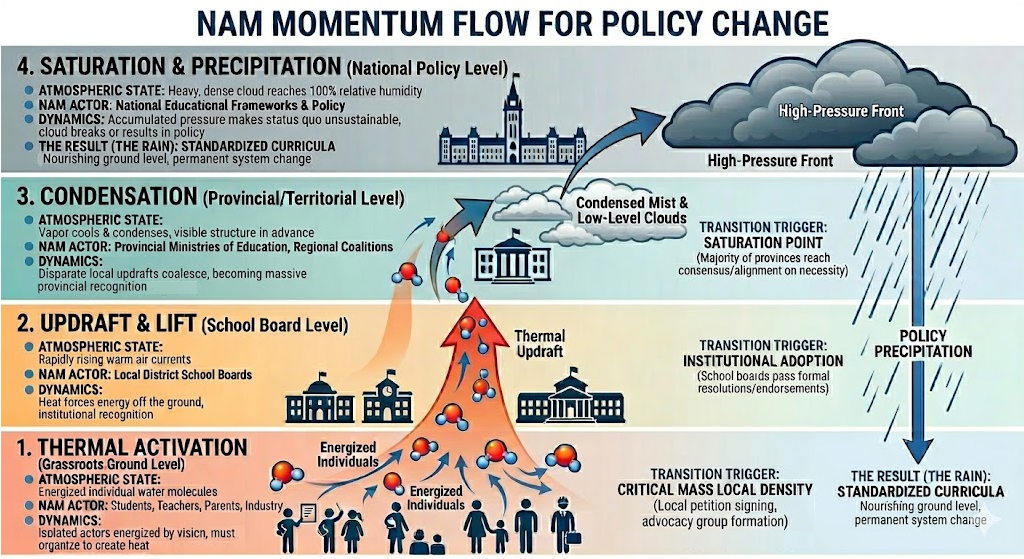
The diagram for NAM Momentum Flow displays a 4-step weather analogy model to illustrate how grassroots pressure translates into national change. The movement flows linearly from the ground up, with key Triggers causing phase changes that advances the campaign.
-
Thermal Activation (Grassroots Ground Level): The cycle starts with individualized energy. Students, teachers, parents, and industry (represented as water molecules) form a movement, organizing locally to generate collective ‘heat’.
-
Updraft & Lift (School Board Level): The concentrated local heat creates a thermal updraft. This movement lifts the petition off the ground and focuses its pressure onto institutional bodies, like local School and University Boards.
-
Condensation (Provincial Level): As regional updrafts coalesce, they become highly visible and structured. At this provincial level, disparate efforts condense into formal, recognized frameworks and regional alignment.
-
Saturation & Precipitation (National Level): Pressure from all provinces hits a tipping point, creating a high-pressure national saturation front. The status quo becomes unsustainable, and the dark cloud breaks.
Policy Rains Down: A uniform National Policy and Curricula pours evenly across the entire country, standardizing education to modern levels, and replenishing the very level where the movement began … and then some!
Key Considerations for Maximum Impact
- Tailor the Language
For administrators/trustees: Focus on cost savings, modernizing education, and student outcomes.
For students/parents: Emphasize ethics, career readiness, and global competitiveness.
For politicians: Highlight economic benefits, innovation, and alignment with international standards. - Leverage Existing Networks
Partner with youth organizations for student petitions.
Collaborate with teacher unions for school board/trustee petitions.
Engage industry associations for university/federal petitions. - Combine with Other Actions
Attach sample letters to MPs to petitions.
Include links to NAM resources (e.g., infographics, FAQs) to educate signatories.
Use social media campaigns (e.g., #NAMNOW) to amplify reach. - Follow-Up Plan:
Deliver petitions in person (e.g., at school board meetings, MP offices).
Request formal responses from targets (e.g., “Will you commit to reviewing NAM adoption by [date]?”).
Publicize results (e.g., “10,000 students demand NAM in BC schools!”).
Printable Petitions
There are 6 types of petitions templates below. Each will be available as RTF files so anyone can open and customize them (i.e., put in school name and logo).
View a sample
Download an RTF file.
Petition for High School Administrators #
Target: Principals, vice-principals, science department heads.
Goal: Replace animal dissection with NAM alternatives (e.g., virtual labs, organ-on-a-chip models) in high school biology curricula.
Signatory:
Students (especially those in biology/chemistry classes);
Parents (concerned about ethical education and career readiness);
Teachers (science educators wanting to modernizing their classrooms);
Alumni (former students who can attest to the limitations of dissection).
Rationale:
High school administrators respond to parental and student demand. A petition with signatures from both groups demonstrates grassroots support and can prompt policy reviews.
Petition for School Trustees/Boards #
Target: Elected school board trustees.
Goal: Allocate funding for NAM tools (e.g., software licenses, teacher training) and update science curriculum standards to prioritize NAM.
Signatory:
Parents (voting constituents in school board elections);
Community members (local advocates, ethical science organizations);
Students (especially those in STEM tracks);
Teachers’ unions (to show professional support).
Rationale:
Trustees are directly accountable to voters and can influence budget allocations and curriculum adoption at the district level. A large, diverse group of signatories (parents + teachers) carries weight.
Petition for University Administrators #
Target: Bio-science faculty deans and department chairs.
Goal: Phase out animal dissection in undergraduate programs and integrate NAM into research and teaching labs.
Signatory:
Students (especially in biology, pharmacology, and pre-med programs);
Faculty (researchers and professors in relevant departments);
Alumni (working in biotech/pharma, who can highlight industry demand for NAM skills);
Industry partners (e.g., local biotech companies, pharmaceutical reps)
Rationale:
Universities are competitive - if peer institutions (e.g., UofT, UBC, McGill) adopt NAM, others may follow to avoid falling behind. Student and faculty signatures show internal demand, while industry support underscores career relevance.
Petition for Provincial Ministries of Education #
Target: Provincial ministers of education and curriculum development teams.
Goal: Mandate NAM inclusion in K–12 science curricula and ban dissection in public schools by 2030.
Signatory:
Parents (across the province);
Teachers (via unions or professional associations);
Student councils (provincial-wide youth organizations);
Advocacy groups (e.g., Humane Canada)
Rationale:
Provincial petitions scale impact - a single policy change can affect all schools in a province. Signatures from teachers’ unions and parent councils add credibility.
Petition for Federal MPs and the Ministry #
Target: Federal MPs, the Minister of Industry (innovation, science, economic), and Health Canada.
Goal: Establish a dedicated federal funding body for NAM education (e.g., $50M/year for tools, training, and research) and tie federal research grants to NAM adoption in universities.
Signatory:
National organizations (e.g., Canadian Federation of Students, Humane Canada);
Scientists/researchers (from universities and industry);
Industry leaders (CEOs of biotech/pharma companies);
General public (via online campaigns)
Rationale:
Federal petitions create national momentum. Signatures from industry leaders and researchers demonstrate that NAM is a scientific and economic priority, not just an ethical one.
Petition for University Student Unions #
Target: Student union executives and general assemblies.
Goal: Pressure universities to adopt NAM in coursework and provide dissection opt-outs for students.
Signatory:
Undergraduate students (especially STEM track);
Student clubs (e.g., pre-med societies, animal rights groups);
Graduate students (in biology, toxicology, etc.)
Rationale:
Student unions have direct influence over university policies. A petition with thousands of student signatures can force administrative action.
Email your Member of Parliament #
To find your MP, type in your postal code here.
It is important to email your MP and get your circle to do it too. MPs may act on behalf of their constituents provided there is enough volume coming in on a topic. Quantity is very important in order to get many politicians to take action.
Be prepared to email more than once. MPs reply personally or through a communications assistant, with a response time that varies between hours, days, weeks, eternities (aka never). The replies can be standard “we will carefully consider your request”, to ones that show your email has actually been read and contemplated.
Do not make assumptions based on political party lines - MPs are individuals and may respond positively or negatively when you least expect it. Do not take things personally - your job is to voice your concern, and not be attached to failure or success.
You may already know exactly what you are going to write, but if you don’t, here are some sample letters that may inspire the Pulitzer in you! The letters are identified by tone (depending on how you are feeling): courteous, pleasant, friendly, urgent, and sycophantic.
(Images below are from Xoom stock collection.)
Courteous #

Subject: Requesting Support for Modernizing Bioscience Education
Dear [MP’s Name],
I hope this message finds you well. As a constituent and science student, I respectfully urge your consideration of New Approach Methodologies (NAM) to modernize Canadian bioscience curricula. While animal dissection remains a common practice, NAM - such as virtual labs and organ-on-a-chip models - offer more accurate, ethical, and cost-effective alternatives. These tools align with global best practices and prepare students for careers in biotech, pharmaceuticals, and regulatory science. For instance, the Netherlands and the US are already phasing out dissection; Canada risks falling behind.
I kindly ask that you take and support initiatives to integrate NAM into education, including dedicated federal funding for teacher training and curriculum modernization. Thank you for your time and commitment to a forward-thinking education system and hope to hear from you soon.
Sincerely,
[Your Name]
[Contact Information]
Pleasant #

Subject: A Quick Note on Upgrading Science Education
Hello [MP’s Name],
I hope you’re having a great day! I wanted to share a thought: Canadian bioscience education could be better if it embraced New Approach Methodologies (NAM). Right now, many schools still use animal dissection - an outdated practice that limits students’ exposure to modern tools. Many universities still adhere to the animal-model which is inaccurate and costly.
NAM, using virtual labs and AI-driven simulations, provides more accurate, less expensive, and more engaging learning experiences. It’s a win-win: students gain skills for future careers, and we align with countries like the US, Australia, and Netherlands. Would you be open to discussing how we can make this happen? I’d love to help with this initiative so please get back to me on this important matter!
Best regards,
[Your Name]
[Contact Information]
Friendly #

Subject: Let’s Update Science Education - Together!
Hi [MP’s Name],
Greetings! I wanted to chat about something that matters to many of us: making sure Canadian students learn bioscience the smartest way possible. Right now, most schools still rely on animal dissection - something that feels more like the 1990s than the 2020s!
New Approach Methodologies (NAM) are the future: they’re safer, more accurate, and way more exciting than traditional labs. Imagine if Canadian students had access to the same cutting-edge tools their peers in the US or Europe use - it could make a huge difference in their careers and our country’s scientific edge!
I’d love to brainstorm how we can push for this change. Let me know if you’re interested in learning more or teaming up with advocates who can help make it happen.
Cheers,
[Your Name]
[Contact Information]
Urgent #

Subject: Canada Is Falling Behind - Act Now on NAM Education!
Dear [MP’s Name],
Time is running out! Canada’s students are being left behind because our bioscience education relies on animal models - an outdated and scientifically inferior practice. New Approach Methodologies (NAM) are the solution: they’re more accurate, cost-effective, and aligned with global standards. The US and Europe are already phasing out animal usage in research; if we don’t act now, Canadian graduates will lack the skills needed for modern careers in biotech and regulatory science.
I urge you to:
- Support federal funding for NAM tools and teacher training.
- Advocate for NAM inclusion in provincial curricula.
- Push Health Canada to prioritize NAM adoption.
This isn’t just about ethics - it’s about competitiveness and the future of Canadian science. The window for change is closing. Will you lead the charge?
Please reply back, and let’s make this change come about.
Sincerely,
[Your Name]
[Contact Information]
Sycophantic #

Subject: A Humble Plea for Visionary Leadership in Education
Dear Most Honourable [MP’s Name],
May this letter find you in radiant health and boundless inspiration, for your leadership shines as a beacon of progress in our great nation. As a devoted constituent and admirer of your unwavering dedication to innovation, I humbly submit this plea for your esteemed support in a matter of profound importance: the urgent modernization of Canada’s bioscience education.
Your visionary stance on ethical and forward-thinking policies is renowned. I implore you to champion the adoption of New Approach Methodologies (NAM) in our schools. These groundbreaking, human-relevant tools - already embraced by global leaders - offer unparalleled accuracy, cost-efficiency, and moral integrity. By phasing out the animal model in favor of NAM, Canada can rise as a global leader in ethical, competitive science education.
I have no doubt that, under your sagacious guidance, Canada will illuminate the path toward a brighter, more humane future for our youth. Thank you for your extraordinary service.
With deepest reverence and admiration,
[Your Name]
[Contact Information]
Videos #
Music has always been ’the wind beneath the wings’ of any justice movement. Here we weave a narrative through a diverse collection of videos which will show the rich heritage you are akin to. Just as these songs fueled the movement for equity through unity and resilience, they remind us that the fight for ethical, modern, and relevant science education is part of that same universal tradition. May those who changed the world before you, inspire your own contribution to this everlasting tapestry.
Jamaican reggae legend, Bob Marley, was a symbol of resistance against social injustice. His music, rooted in the struggles of the oppressed, inspired movements for equality, freedom, and human rights worldwide. May the powerful rhythm, and the words cause you to Get Up Stand Up!
Times They Are A Changing is one of Bob Dylan’s best known protest songs. Written in 1964, during cultural and social upheavals, it was a warning to those determined to resist fairness and justice. The Vancouver Youth Choir with flowing harmonic beauty brings us the inevitability of change.
However, the inevitable may not simply waltz in on its own. You sometimes have to keep ‘kicking at the darkness till it bleeds daylight’ to paraphase Bruce Cockburn. Intelligently planned initiatives will get that daylight to break through, but solidarity to the goal must be maintained. Pete Seeger was a revolutionary American singer, songwriter, and activist who used music as a tool for change, championing civil, labor, and environmental rights. His We Shall Not Be Moved embodies the spirit of collective action, expressed with clarity and energy by The Seekers.
The Boston Children’s Choir performs two gems bursting with defiance. Tshotsholoza is a South African mineworker’s song of resistance against apartheid with a call-response style melody underpinning the idea “we are marching”. They follow with the civil rights gospel Ain’t Gonna Let Nobody Turn Me Around demonstrating the unwavering commitment to justice and equality which cannot be stopped by any obstacle!
The enduring anthem We Shall Overcome symbolized perseverance and hope during the civil rights era. It became a global rallying cry. The enduring activist, Joan Baez, sung it with her crystal, radiant voice, making it a bright point of resilience maintaining that hatred and injustice can be overcome through collective and effective action.
Possibly Pete Seeger’s best known work, If I Had A Hammer written with Lee Hays in 1949, stresses that the tools to work with are already available to us! Translated into multiple languages, this iconic piece inspired a generation of artists, including the famed trio Peter, Paul, and Mary, who turned it into a dynamic call to action, reminding us that everyone has a role to play in building a more equitable world.
The East African love song, Malaika (Angel) written by Adam Salim, transcended its original romantic longings, and became a symbol of hope against unfair norms. The simple, yet haunting melody is harmonized by two fierce activists. Harry Belafonte was a champion for civil rights in the USA and beyond. Miriam Makeba was the legendary “Mama Africa” whose work against apartheid caused her to be exiled from her homeland of South Africa for 30 years, during which she used her presence to help end the malignant racial structure of that country. This version exhibits beautiful artwork to accompany their glorious voices.
From Toy Story, the playful You’ve Got A Friend In Me by Randy Newman, has a core message embedded in it that unity and loyalty are undeniable givens! None of us are alone in this venture and we can rely on, encourage, and support each other, no matter ‘how rough the road ahead’ may be. This version is delightfully comedic and performed by Celtic Thunder.
Bruce Springsteen wrote this gospel inspired work in 1999. It is an uplifting, working-class anthem composed by someone who is much more than a rockstar. Springsteen is a lifelong activist, supporting labor rights, veterans, and racial equality. He used his platform to fight injustice, to inspire change … and he’s still at it! No wonder he’s known as “The Boss”! In this song, the American Dream is re-conceived through the metaphor of a train journey. The train passengers include saints and sinners, losers and winners, all travelling together despite hardships, all moving forward past obstacles, all trying to get to that Land Of Hope And Dreams.
The traditional gospel song This Little Light of Mine demands that you let your own inner light shine. Every advocate has a role to play and each time someone speaks out, refusing to tolerate discrimination and injustice, a part of the darkness is seared away. This version is done by the bluegrass group The Lower Lights who blend spirituals, appalachian, and other American influences to create an inclusive energy.
Walking on Sunshine by Katrina and the Waves is a mid-80s joyful song with an upbeat tempo, and energetic brilliance. It is a celebration of triumph and happiness, after the ’trials and tribulations’ have been met and overcome. The group Kontrollverlust provides a particularly high-powered version which gives you a glimpse of what victory is like after we have ‘climbed that mountain’ and ‘crossed that river’. We will indeed be walking on sunshine and it’s going to feel good!