
OrgaNAMization #
New Approach Methodologies (NAM) are the future of biomedical science and Safety Assessment via NAM, including toxicology. The people who engage with NAM today, whether students, researchers, or community members, will lead the field tomorrow.
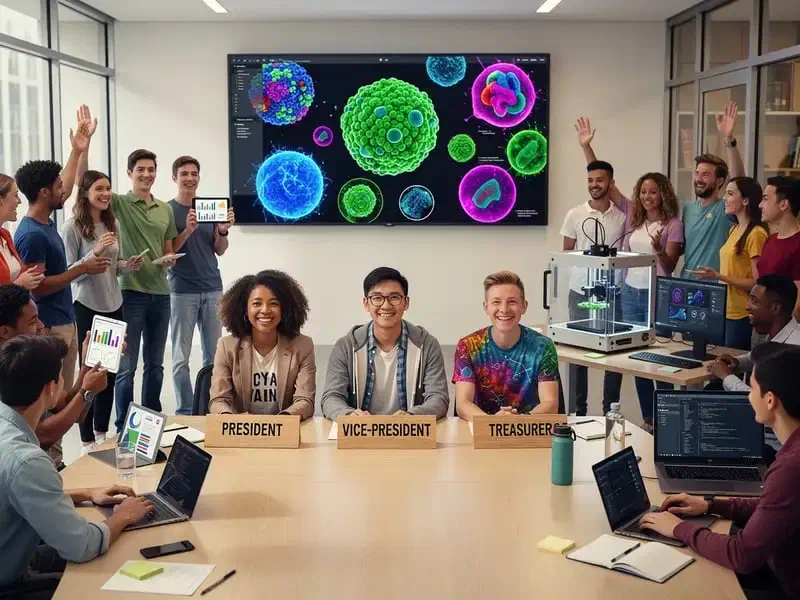
leading a room of energized and of course dynamic members.
Credit: Mistral
Forming a NAM group or club is the most direct way to build that engagement: it creates a community of curious minds, gives members a structured path into the field, and connects them with researchers and companies already working with NAM. This guide covers the two most common settings, high schools and universities, though the same approach applies to any institution or group.
Getting Started by Level #
The tasks below are common to both institutions; only their scope and sophistication differ.
| Task | High School | University |
|---|---|---|
| Founding and approval | Propose the club to the school administration with a short constitution and a faculty sponsor. | Constitute a recognized student society: constitution, executive committee, faculty advisor, and society bank account. |
| Faculty support | Recruit a science teacher as sponsor; partner with existing science clubs rather than duplicating them. | Secure a faculty advisor in a relevant department and, where possible, an industry mentor. |
| Meetings | A regular meeting slot, brief and accessible: screenings, lay-article discussions, and demonstrations. | A seminar or reading-group cadence with assigned papers and member-led presentations. |
| Activities | NAM video screenings, journal-club style discussion of accessible articles, science-fair projects using open datasets, and invited talks from local universities. | Reading groups on NAM papers, lab tours, hackathons around computational toxicology or organoid datasets, career panels with industry contacts, and collaborative research projects. |
| Speakers and outreach | Invite local university researchers or industry scientists for accessible talks. | Host researchers directly; draw speakers from PNARS network contacts in industry. |
| Funding and resources | Small grants from the school, science department budgets, or society funding for school clubs. | University society funding, research grants, departmental co-sponsorship, and industry sponsorship. |
| Ambition and progression | Build curiosity and foundational literacy in NAM. | Progress to sophisticated engagement: critical appraisal of methods, participation in research, and pathways to internships and graduate study. |
Naming Your Group #
A distinctive name helps a new group establish its identity. Consider adopting one of these:
- ClaNAM — a close-knit community united around NAM.
- AlliNAMce — a broad coalition of supporters and partners.
- SyNAMdicate — a group dedicated to advancing NAM.
Or you could go more traditional with NAM club or NAM group.
Practical Toolkit #
Sample club constitution #
Sample Constitution of the [Club Name] NAM Club
Adapt the bracketed sections to your institution. If you have not yet chosen a name, consider Clanam, Allinamce, or Namdicate.
Article I — Name
The name of this organization shall be the [Club Name] NAM Club, referred to herein as the Club.
Article II — Mission
The Club exists to explore and advance New Approach Methodologies (NAM): modern, human-relevant methods in biomedical science and Safety Assessment via NAM, including toxicology, such as organoids, organs-on-chip, and computational models. The Club builds scientific literacy, connects members with researchers and industry, and supports members in projects, internships, and study pathways related to NAM.
Article III — Membership
Membership is open to any student of [School / Institution Name] with an interest in NAM, regardless of program or prior experience. There are no entry requirements; curiosity is the only qualification. Membership is maintained by attending at least [two] meetings per term.
Article IV — Officers
The Club shall have three officers, elected annually:
- President — sets meeting agendas, chairs meetings, and serves as the Club’s primary contact with the institution and external partners.
- Vice-President — supports the President, organizes events and speakers, and chairs meetings in the President’s absence.
- Treasurer — manages dues and finances, keeps accounts, and prepares a brief financial report at the end of each term.
There may also be a Secretary who records minutes, maintains the membership list, and manages the Club’s correspondence and records, though this role can be filled on a rotation basis by different individuals. Meeting minutes may also be produced by recordings which are transcribed by a designated individual or by AI.
One person may not hold two officer positions simultaneously.
Article V — Faculty Advisor
The Club shall be supported by a Faculty Advisor, [a science teacher / a member of the faculty] who provides guidance, facilitates institutional approvals, and assists with speaker outreach.
Article VI — Elections
Officers are elected at the [first / final] meeting of [September / April] by a simple majority of members present. Nominations are open to all members. Elections are conducted by [secret ballot / show of hands].
Article VII — Meetings
The Club shall meet at least [twice per month] during the academic year, at a time and place fixed at the start of each term. Quorum is [one third] of active members. Meetings may include screenings, paper discussions, demonstrations, speaker events, and planning sessions.
Article VIII — Finances
Membership dues are [amount / waived], set annually by majority vote. All funds are held for Club activities. The Treasurer reports the balance at each regular meeting. The Club may accept donations, grants, and sponsorships consistent with institutional policy.
Article IX — Activities and Conduct
The Club’s activities shall reflect its mission and a positive, collaborative spirit. Members shall treat one another, guests, and the wider community with respect and courtesy.
Article X — Amendments
This Constitution may be amended by a two-thirds vote of members present at any regular meeting, provided the amendment was circulated at least [one week] in advance.
Ratification
This Constitution takes effect upon approval by a majority of founding members and [the school administration / the students’ union].
Adopted on [date] by the founding members of the [Club Name] NAM Club.
Meeting agenda template #
Sample Meeting Agenda
Adapt the durations to your club’s meeting length. The suggested timing assumes a sixty-minute meeting.
[Club Name] NAM Club — Regular Meeting Agenda
Date: [date] Time: [start] to [end] | Location: [room / video call link]
-
Call to Order (2 minutes) — The President opens the meeting and welcomes members, including any first-time attendees.
-
Minutes of the Previous Meeting (5 minutes) — The minutes, produced from the last meeting’s recording by this meeting’s designated transcriber or by AI, are reviewed and adopted. Corrections, if any, are noted.
-
Officer Reports (8 minutes)
- President: upcoming events and institutional matters.
- Vice-President: speaker outreach and event planning.
- Treasurer: balance, dues, and funding updates.
-
Old Business (5 minutes) — Follow-up on action items from the previous meeting. Each item names its owner and its status.
-
Main Program (30 minutes) — The heart of the meeting. Choose one format per meeting:
- Screening: a NAM video, followed by open discussion.
- Paper Club: an accessible NAM article presented by a member, followed by questions.
- Demonstration: a hands-on walk-through of an open dataset or computational tool.
- Speaker Event: an invited researcher or industry scientist presents, followed by a question period.
- Planning Session: preparation for a fair, showcase, or outreach activity.
-
New Business (5 minutes) — Proposals raised for the first time. Items requiring discussion are added to a future agenda.
-
Action Items and Announcements (3 minutes) — The meeting’s action items are read aloud with owners and deadlines. Upcoming dates and opportunities are announced.
-
Adjournment (2 minutes) — The President closes the meeting. The next meeting date is confirmed. The recording for minutes is stopped and handed to the designated transcriber.
Standing Rules
- Record every meeting for transcription, unless a member objects; in that case, pause the recording during their remarks.
- Post the adopted minutes and the next agenda to the club’s channel within [48 hours].
- Every action item has an owner and a date; no item closes without both.
Poster and outreach templates #
Adapt the bracketed details to your club. Keep the tone positive: you are inviting people into the future of science.
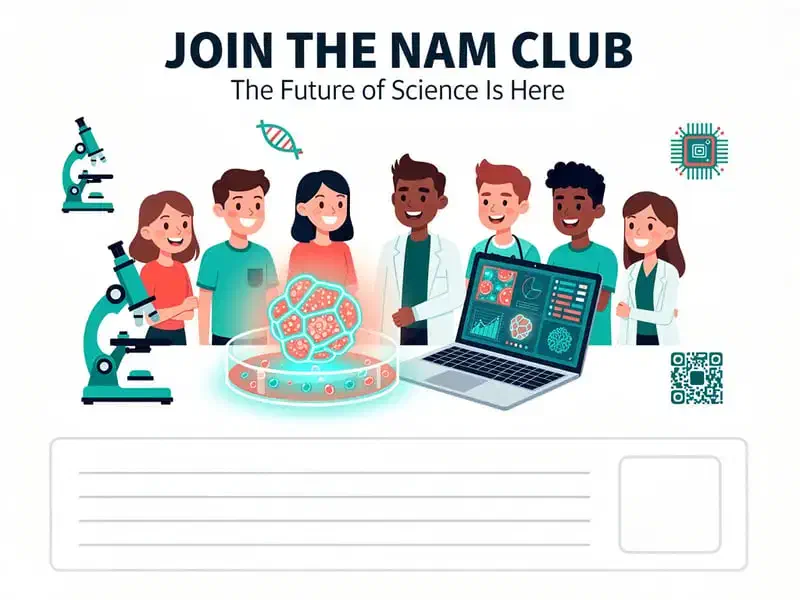
Sample NAM club poster
with space for your meeting details.
Credit: Mistral
Recruitment Poster Copy
JOIN THE NAM CLUB The Future of Science Is Here
Explore organoids, organs-on-chip, and computer models of human biology. No lab coat required. Curiosity is the only qualification.
When: [day and time] Where: [room] | Join: [link or QR code] All students welcome.
Classroom Announcement (30 seconds)
“Hi everyone — we are starting a NAM club at [School Name]. NAM stands for New Approach Methodologies: the modern, human-based ways science is done today, like organoids and computer models. We watch great videos, discuss real articles, hear from working scientists, and do projects you can take to the science fair. No experience needed. Our first meeting is [day, time, room]. Come see what the future of science looks like.”
Social Media Post
Science is changing — and it looks NAMazing! [School Name]’s new NAM club explores organoids, organs-on-chip, and AI models of human biology. First meeting: [day, time, room]. Everyone welcome. #NAM #FutureOfScience #[club name]
Outreach Email to Potential Members
Subject: A new kind of science club
Hi [Name],
We are launching a NAM club at [School Name], and you are exactly the kind of person we hope will join. NAM — New Approach Methodologies — is how modern biomedical science gets done: organoids, organs-on-chip, and computational models that are faster, more human-relevant, and more exciting than the old ways.
Our first meeting is on [day] at [time] in [room]. There will be a short screening, good discussion, and snacks. No experience or lab coat required.
Could you let me know if you can make it? Everyone is welcome.
With thanks,
[Your name],
[President / on behalf of the [Club Name] NAM Club]
A starter syllabus and resource list #
This resource points members to reliable NAM materials. These are example possibilities, but not recommendations. The amount of available resources is enormous (see PNARS Library), so depending on the nature of the club, the selections should vary.
Work through the units in order; each builds on the last. A high school club can complete one unit per meeting; a university club can go deeper into the readings and datasets of the same units.
Unit 1 — What Is NAM?
- Watch and discuss: an introductory NAM video from the PNARS Library.
- Key idea: New Approach Methodologies are modern, human-relevant ways of doing biomedical science, including Safety Assessment via NAM and toxicology.
- Activity: members share what drew them to the club.
Unit 2 — Why Human-Relevant Science
- Key idea: models built from human cells and human data are the future of drug development and safety testing, and the field is gaining momentum worldwide.
- Read: NAMs Explained for a plain-language overview.
- Activity: brainstorm where NAM could improve medicine your members care about.
Unit 3 — Organoids
- Key idea: miniature, self-organizing organs grown from human cells.
- Read: What are NAMs? for the science behind 3D culture systems.
- Activity: watch an organoid time-lapse; sketch and label the cell types in a brain or gut organoid.
Unit 4 — Organs-on-Chip
- Key idea: microfluidic chips that mimic living organs with realistic flow and forces.
- Learn: the STEP4NAMs EDUCATE programme offers free modules on organ-on-chip technologies.
- Activity: design a poster describing what a lung-on-a-chip does.
Unit 5 — In Silico and AI Models
- Key idea: computers predict how chemicals and drugs behave in the human body.
- Explore: the EPA Computational Toxicology and Exposure Online Resources, a free public resource with chemistry, toxicity, and exposure data on over one million chemicals.
- Activity: look up a household chemical in the Dashboard and report what the data shows.
Unit 6 — Safety Assessment via NAM
- Key idea: how modern safety testing works, including toxicology, without the old limitations (e.g., Asbestos Testing Emerging Trends)
- Discuss: why regulators are adopting these methods.
- Activity: read and discuss the FDA’s recent steps toward organoids and organs-on-chip in drug evaluation.
Unit 7 — The NAM Ecosystem
- Key idea: companies, institutes, and regulators around the world are building the NAM economy.
- Read: New approach methodologies gain momentum for real research examples.
- Activity: invite a speaker, or watch and discuss a recorded talk by a working scientist.
Unit 8 — Careers and Pathways
- Key idea: NAM skills open doors in research, industry, and regulation (e.g., Creating training opportunities in new approach methodologies for early-career researchers).
- Activity: each member identifies one NAM career path and the study route to it.
Unit 9 — Club Project Night
- Activity: members present a project, video essay, or dataset exploration. Invite other students and a science teacher.
Where to Find More
- The PNARS Library: articles, posts, and videos on NAM.
- The PNARS Network: companies and researchers working with NAM.
- The EPA NAMs Training Site: free training on the Dashboard and related tools.
- The STEP4NAMs EDUCATE modules: free expert-led training across NAM technologies.
An outreach email template for inviting speakers. #
Personalize the bracketed sections, and send from the club’s official address where possible. A warm, specific email receives far more replies than a generic one.
Subject: Invitation to speak at the [Club Name] NAM Club at [School / Institution Name]
Dear [Dr. / Prof. / Mr. / Ms.] [Name],
I am [writing on behalf of / a member of] the [Club Name] NAM Club at [School / Institution Name]. Our club brings together students who are excited about New Approach Methodologies — the modern, human-relevant ways biomedical science is being done today, such as organoids, organs-on-chip, and computational models.
We would be honoured to have you speak to our club about [your work on / your organization’s approach to] [specific topic, referencing their research, product, or a talk of theirs you admired]. [Variant for universities: Our members are especially interested in [your recent paper / your lab’s work] on [topic].] [Variant for high schools: Our members range from [grade] to [grade], so an accessible talk with striking visuals lands wonderfully with this audience.]
The details, all flexible to your schedule:
- Format: [a 20–30 minute talk followed by questions]
- When: [proposed date(s) and time]
- Where: [room on campus / a video call, whichever you prefer]
- Audience: [number] students with a genuine interest in NAM
We will promote your talk to our members and handle all arrangements, including the room, technology, and recording if you consent. Recording is only for our internal minutes, and we will gladly omit it at your request.
If you are interested, I would be happy to share further details or arrange a brief call at your convenience. Thank you very much for considering this invitation; we recognize your time is valuable, and we are grateful for any consideration.
With thanks,
[Your name]
[President / on behalf of the [Club Name] NAM Club]
[School / Institution Name] [club email] | [club social media or website]
Community and Recognition #
- A registry of active NAM clubs, so newcomers can find or contact one.
- Recognition for members and clubs: certificates, and an annual virtual showcase of member projects.
- Connection to the wider NAM community through PNARS and its network.
Frequently Asked Questions #
Do we need a laboratory?
No. NAM work is largely computational and literature-based, so a club does not require wet-lab facilities.
What if a faculty member is skeptical?
NAM is a rapidly maturing, scientifically rigorous field. Invite a speaker to demonstrate its strength, and stress the technology’s promise.
What if membership is low at first?
Most successful clubs begin with a handful of committed members. Consistency matters more than numbers. A small, dedicated core that builds the membership is almost always more effective than starting with a large group where most people join because they are pursuing the latest ‘fad’.
What if someone insists that animal research is the gold standard?
Listen first, then answer on the merits. The question that matters is which methods best predict what happens in human beings — and that is precisely where NAM excels, because its models are built from human cells and human data. The high rate of drug failures in human trials is widely acknowledged even by defenders of current practice: the debate is over the interpretation, not the number. Meanwhile, NAM methods are earning their place on performance — for example, liver-chip models have correctly identified toxicity that animal tests missed. Point to the evidence, invite a speaker, and let the technology’s promise make the case. You will rarely change a mind in one conversation, but a courteous, well-informed club wins the room. It is important to use resistance to further strengthen one’s position.
Is NAM accepted by regulators?
Yes, and increasingly so. Regulatory agencies worldwide, including the FDA, are actively adopting NAM methods and signalling that drug sponsors may rely on them. Safety Assessment via NAM, including toxicology, is a growing part of the regulatory toolkit. A club member who learns NAM today is learning the methods their generation will regulate with.
How should we handle hostile questions at a club event?
With courtesy and confidence. Thank the questioner, answer what you can from the syllabus materials, and offer to follow up by email with sources. Never let a discussion become a debate about motives: keep the conversation anchored on human-relevant science and what it delivers. If a question exceeds the club’s knowledge, that is a victory, not a defeat — it shows the club is engaging with serious questions, and it makes an excellent topic for a future meeting.
Do members need a biology background?
Absolutely not. NAM is inherently interdisciplinary: it needs coders and data enthusiasts as much as biologists, plus writers, designers, and organizers. A member who can build a spreadsheet or a slide deck contributes as meaningfully as one who can explain a pathway. The only genuine requirement is curiosity.
What can a small club really contribute?
Quite a lot if it is well-organized and active. Clubs expand the community of people who understand NAM, seed it into their generation, and connect their schools and universities with researchers and companies. PNARS itself grew from people who simply decided to act. A club of five enthusiastic members has started many great things.