
Animal Research vs NAM Expenditures #
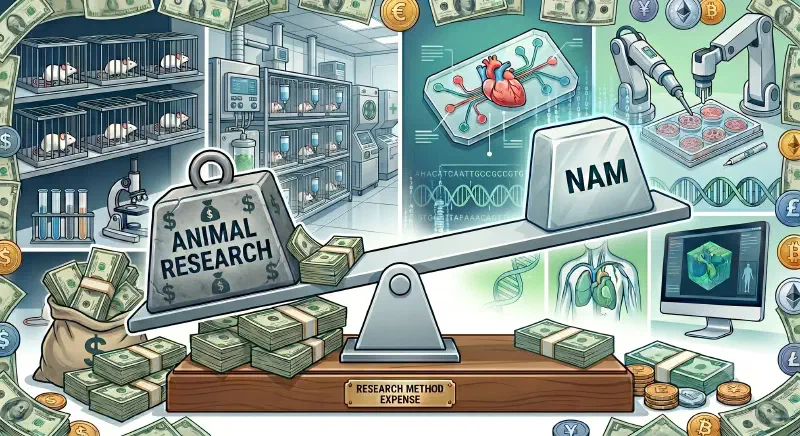
Credit: Gemini
This is a comprehensive and thoroughly referenced report on severe expenditures required for animal research compared to NAM. It shows a multi-scalar comparative economic analysis of traditional in vivo research vs new approach methodologies in biopharmaceutical R&D.
(All dollar values are in USD as of 2026-06 and from the references cited. Be aware that financial numbers may vary dependent on source, methodology, and point-of-time for the analysis.)
Key points covered in the analysis:
- The 95% Preclinical Bottleneck: Traditional R&D workflows fail at the very start, with 95% of discovered drugs thrown out during slow, animal-based laboratory tests before ever reaching a human subject.
- The 92% Clinical Translation Gap: Out of the tiny fraction of candidate drugs that survive animal screens, up to 92% fail immediately in human clinical trials because animal-based modeling cannot accurately replicate human biological responses.
- The Attrition-Loaded Cost Range ($1.9B to $2.6B): Running a pipeline crippled by these compounding failures drives the total estimated cost of a single approved drug to a range between $1.9 billion and $2.6 billion, depending on the tracking source and methodology used.
- Predictive Superiority and Precision: Modern alternatives like human organ-chips simulate actual patient biology with remarkable accuracy, correctly identifying severe toxicities and efficacy liabilities that legacy animal methods completely miss.
- Sublinear Data Scaling: Unlike physical testing models that require a linear increase in animal procurement, breeding, and space, automated systems and virtual computing platforms process millions of compounds at a sublinear, fractional cost.
- Significant Lifecycle Savings: Transitioning from volatile animal models to automated cleanrooms secures up to 26% system-wide R&D cost reductions, delivering over $42 million in direct cumulative savings per facility line over a 15-year developmental horizon.
Introduction #
The biopharmaceutical research and development sector has reached an unsustainable economic threshold. The fully capitalized, attrition-loaded cost required to progress a single drug from initial discovery to regulatory approval has escalated to an average ranging between $1.9 billion and $2.6 billion, depending on the tracking source and methodology used and takes between 10-15 years 1 2 3. This financial burden is fundamentally driven by a late-stage translation gap in clinical trials, where up to 92% of therapeutics validated as safe and effective in animal models fail during human clinical trials due to unrecognized toxicities or a lack of efficacy 2. Preclinical attrition rates hover around 95% before candidate drugs ever reach a human subject3. Subsequent phase progressions (I,II,III) are dismally inefficient as well3. This systemic reliance on live biology creates a highly capital-intensive and slow-velocity research paradigm.
This economic analysis evaluates the transition from traditional animal-based testing to New Approach Methodologies (NAM), including Organ-on-a-Chip (OOC) systems, high-throughput screening (HTS), human organoids, in silico modeling, and artificial intelligence-driven drug discovery. Expert consensus models indicate that the systemic adoption of NAM yields an average total R&D cost reduction of 10% to 26% (with a median savings of 19%), translating to absolute capitalized savings between $276 million and $706 million per drug4.
The legal enabling of these technologies by the FDA Modernization Act 2.0 has initiated a critical market inflection point where the superior human-predictive validity, compressed cycle times, and reduced physical footprint of NAM render legacy vivarium-based paradigms economically obsolete5.
The global animal model market represents a compounding financial liability for the industry, valued at $2.93 billion in 2025 and projected to balloon to $6.6 billion by 20356. To mitigate exposure to these escalating legacy costs, the economic case for an operational transition to NAM establishes an alternative framework resting on three multi-scalar pillars:
- Sublinear Marginal Cost Scaling: Traditional animal models scale linearly or at an increasing marginal cost, where every additional data point mandates the physical procurement, housing, and disposal of an animal cohort. Conversely, computational in silico screening and automated HTS platforms operate on a sublinear cost curve, driving the marginal cost per data point down to fractions of a cent and enabling massive, parallelized chemical library screens at unprecedented velocity.
- Superior Human-Predictive Validity: While historical animal testing models exhibit a poor 30% to 50% concordance rate for human toxicity endpoints7, microfluidic human Organ-Chips achieve up to 87% sensitivity and 100% specificity in predicting critical human toxicities, such as drug-induced liver injury (DILI)8. De-risking compounds prior to clinical entry fundamentally alters the clinical trial success curve.
- Timeline Compression and Maximized NPV: Transitioning from the biological constraints of animal breeding and gestation to automated assays and AI candidate screening compresses preclinical discovery timelines by 12 to 24 months. For a blockbuster therapeutic, this accelerated time-to-market extends effective patent exclusivity, generating between $500 million and $1 billion in incremental Net Present Value (NPV)9.
This report outlines the multi-scalar economic parameters of this transition, defining a risk-mitigated strategy for phased implementation suitable for senior leadership decision-making.
Micro-Economic Analysis: Operational Efficiency at the Lab Bench #
The operational architecture of biopharmaceutical R&D is undergoing a fundamental restructuring at the individual laboratory scale. Traditional preclinical workflows are structurally bound by live biological systems, which enforce rigid, linear cost-scaling models and high operational headcount requirements. Transitioning to a NAM-based paradigm shifts the laboratory benchmark from resource-intensive manual husbandry to highly automated, parallelized, and data-dense platforms.
This micro-economic evaluation deconstructs the direct inputs, infrastructure overheads, and labor distributions that define the day-to-day cost of data generation. By analyzing these variables, senior leadership can assess the granular efficiency gains realized when substituting traditional in vivo models with highly scalable, non-animal methodologies.
Direct Consumables & Procurement #
The direct procurement of biological models and technological inputs reveals a stark divergence in cost-efficiency and scaling performance. Legacy preclinical research relies on animal cohorts that face escalating cost exposure and high market volatility driven by geopolitical tensions, supply chain blockages, and shifting export policies. For instance, a routine pharmaceutical toxicology evaluation utilizing non-human primates (NHPs), such as macaque monkeys, frequently subjects sponsors to procurement and maintenance liabilities reaching up to $50,000 per animal10. Standard small animal pipelines rely heavily on rodent configurations; however, while a basic wild-type mouse carries a modest upfront purchase price, specialized transgenic, humanized, or immunocompromised murine cohorts engineered for specific human disease translation can scale past thousands of dollars per breeding cohort11. These procurement metrics capture only the initial entry threshold, as live biological systems demand immediate, continuous operational funding. When accounting for mandatory animal facility expenditures - encompassing daily specialized husbandry, strict dietary feed regimes, climate-controlled vivarium operations, and veterinary intervention - maintaining even a baseline preclinical mouse model regularly adds substantial recurring costs over the life of a standard research protocol12.
In contrast, the consumables and microfluidic components of NAM platforms exhibit predictable price normalization driven by industrialized manufacturing processes. While highly specialized organ-on-a-chip models, such as mature microfluidic liver models, can require initial custom engineering and design investments between $20,000 and $150,000 depending on integrated biosensors and custom biomaterial structures, standardized commercial microfluidic chips are highly accessible. Standard single-layer polydimethylsiloxane (PDMS) and glass chips are available at $60 per chip in quantities of 10013, while standardized microfluidic cross-flow membrane chips are $100, and channel-interaction chips are $45 (per unit). High-fidelity tissue packs, such as barrier organ-on-a-chip setups, are commercially packaged in tens for $4,45014. (See reference for various configurations.)
On an ongoing operational basis, high-fidelity primary cell lines and iPSC-derived cells carry initial vial costs of $500 - $5,000, yet they scale efficiently into standardized microfluidic setups and organoid batches costing just $50 - $150 per run while generating hundreds of human-relevant data points15. Once acquired, these lines scale efficiently into parallelized microfluidic setups and automated, localized organoid assay cultures at a minimal downstream fraction of their acquisition costs while generating hundreds of human-relevant data points.
The operational cost-efficiency of this transition is demonstrated by comparative screening programs. In a target validation and toxicity evaluation program, screening 35 lipid nanoparticles (LNPs) using human Liver-Chips was achieved for $325,000 over 18 months, whereas the equivalent screening program using traditional in vivo NHP models would exceed $5,000,000 and require over 60 months to execute. This represents a 15-fold reduction in direct capital outlay and a 70% compression in operational cycle time.
Furthermore, computational in silico drug discovery and virtual screening completely leverage cloud-integrated storage and elastic compute engines. By transitioning from legacy on-premise high-performance computing (HPC) hardware to on-demand cloud services, laboratories minimize fixed capital assets. Compute nodes scale dynamically during peak screening campaigns and automatically de-provision resources upon completion, ensuring sponsors pay only for the compute cycles actually consumed16. According to documented architectural benchmarks for high-throughput virtual screening platforms, these workloads scale with perfect parallelized efficiency across elastic batch clusters17. By utilizing fault-tolerant configurations - such as cloud spot instances - sponsors cut standard cloud compute expenses by up to 70% to 90%, enabling the exhaustive screening of millions to billions of compounds for a fraction of traditional IT overheads while completely bypassing the millions of dollars required for physical compound library synthesis and legacy wet-lab animal assays.
Traditionally, maintaining an in-house HPC environment capable of processing vast chemical libraries requires substantial localized capital expenditure, with specialized hardware clusters demanding initial outlays between $65,000 and $650,000 alongside recurring annual support and maintenance overheads reaching up to $400,00018. By transitioning these analytical workloads to elastic cloud-integrated environments, laboratories minimize these fixed capital assets down to $018. Empirical benchmarks for ultra-large structure-based screens demonstrate that screening an extensive library of 4.5 billion molecules can be executed on cloud infrastructure for a predictable operational bill of approximately $25,000 - averaging just $30 to $40 per million compounds processed18. This fluid, utility-based billing allows teams to evaluate immense regions of chemical space within days, bypassing the multi-month timelines inherently required to physically screen large compound libraries or execute legacy in vivo protocols. An example of an architecture capable of orchestrating these ultra-large virtual screens with perfect scaling behavior across heterogeneous Linux clusters and cloud environments is the open-source platform VirtualFlow19.
| Procurement Category | Legacy In Vivo Model Details | NAM Alternative Platform Details | Unit Cost Range (USD) |
|---|---|---|---|
| Non-Human Primate (NHP) | Single NHP procurement and maintenance liabilities10 | Standardized human multi-organ-on-chip models featuring integrated biosensors15 | Up to $50,000 per animal vs. $20,000 - $150,000 custom setup |
| Rodent Cohort (Murine) | Transgenic, humanized, or immunocompromised breeding cohorts11 | Human iPSC-derived organoid culture runs or automated assay setups15 | Past thousands per cohort vs. $50 - $150 per organoid run |
| Microfluidic Consumable | N/A (Legacy biological testing model) | uFluidix single-layer PDMS or glass chips13 | $60 per chip (ordered in quantities of 100) |
| Specialized Chips | N/A (Legacy biological testing model) | Standardized cross-flow membrane or channel-interaction chips14 | $100 per membrane chip / $45 per channel chip |
| High-Fidelity Tissue Pack | N/A (Legacy biological testing model) | MEPSGEN MEPS-TBC barrier organ-on-a-chip packs14 | $4,450 per commercial pack of 10 |
| HPC Compute Credits | In-house high-performance hardware clusters ($65,000 - $650,000 upfront)18 | Elastic cloud batch instances running distributed docking software1619 | $65,000 - $650,000 fixed asset cost vs. $30 - $40 per million compounds docked |
Human Capital & Labor #
Transitioning from animal models to NAM shifts the human capital mix from low-complexity manual labor to highly specialized technical personnel. Traditional vivarium operations are highly headcount-intensive, demanding a large volume of animal care technicians, facility managers, and specialized veterinary support staff to manage daily husbandry cycles. According to the U.S. Bureau of Labor Statistics, the baseline median compensation for laboratory animal caretakers and veterinary assistants is around $40,000 per year20, though specialized personnel embedded directly within pharmaceutical and medicine manufacturing segments can earn considerably more. When managing complex or highly sensitive preclinical testing cohorts, highly experienced in vivo preclinical research specialists and senior veterinary technicians command billing rates ranging from $26 to $35 per hour, representing an annual salary baseline of $54,000 to $72,000. Managing a mid-sized facility housing a fleet of 10,000 animal cages routinely forces sponsors to maintain a persistent headcount of 15 to 25 full-time animal care staff, creating an inflexible, escalating operational salary floor.
Conversely, the deployment of NAM, automation, and computational biology requires a lean, specialized workforce composed of bioinformaticians, data scientists, hardware bioengineers, and stem cell culture specialists. Within the biopharmaceutical and biotechnology industry sectors, entry-level computational analysts command starting salaries of $75,00021. For mid-level professionals and applied data science specialists, median salaries scale rapidly to $130,000-$185,000. At the pinnacle of the technical architecture, senior AI data science leads, principal scientists, and chief data scientists command premier industry compensation packages often over $200,000 annually22.
Although the wage premiums and individual compensation metrics for computational and advanced bioengineering personnel are significantly higher than legacy animal handlers, the total operational labor density is greatly reduced. Automated liquid handling systems, high-throughput imaging, and parallelized cloud computing workflows allow a small team of data scientists and bioengineers to generate, process, and analyze datasets containing millions of independent data points. This operational model vastly outperforms the data output of a traditional vivarium staff on a per-capita basis, driving the long-term human capital expenditure per data point down by a factor of 10-fold to 100-fold.
| Labor Classification | Legacy In Vivo Operations (Annual Cost Baseline) | NAM Alternative Operations (Annual Cost Baseline) | Labor Density per 10,000 Compounds |
|---|---|---|---|
| Entry Level / Technical Support | Animal Care Technician I/II: Around $40,00020 |
Stem Cell Culture Specialist / Junior Computational Analyst: Starting at $75,00021 |
High (In vivo manual dosing and cage-cleaning cycles) vs. Low (Automated microfluidic workflows) |
| Mid-Level Professional | Experienced Preclinical Specialist / Senior Vet Tech: $54,000 - $72,000 |
Applied Data Science Specialist: $130,000 - $185,000 |
High (Daily manual tracking and physiological monitoring) vs. Low (Algorithmic simulation and data curation) |
| Senior Management / Principal | Vivarium Director / Laboratory Pathologist: $90,000 - $135,000 |
Senior AI Research Lead / Chief Data Scientist: Over $200,00022 |
Extreme (Species-specific biological oversight and regulatory protocols) vs. Very Low (Scalable digital pipeline designs) |
Facility Operations & OPEX Boundaries #
Operational expenditures (OPEX) are heavily dictated by the aggressive environmental and biosecurity controls required to maintain live animal cohorts. Small animal laboratories demand intensive heating, ventilation, and air conditioning (HVAC) operations to mitigate localized odors, heavy heat loads, and continuous ammonia buildup. This requires continuous air exchange rates of 10 to 15 air changes per hour (ACH) for rodent housing, scaling up to 15 to 20 ACH for specialized quarantine, barrier, surgery, and necropsy environments23. Vivariums must operate under continuous negative pressure configurations to prevent allergen and pathogen escape, while maintaining strict relative humidity bands between 30% and 70% and temperature thresholds between 18°C and 26°C23.
Because laboratories consume three to five times more energy than standard commercial offices, and over 60% of this energy is consumed entirely by HVAC ventilation and exhaust systems, the mechanical utility cost of a vivarium represents a massive, recurring OPEX liability24. These costs are exacerbated by the maintenance of individually ventilated caging (IVC) systems, which require upfront capital investments of $15,000 to $40,000 per rack, plus ongoing costs of $500 to $1,000 annually for HEPA filter replacements and specialized high-throughput cage washing and autoclave sterilization equipment25.
In contrast, automated cleanrooms and microfluidic testing environments utilize modular or mobile cleanroom architectures26. These systems integrate directly with standard building utilities and can be rapidly reconfigured26. They do not require the continuous bio-effluent scrubbers, ammonia exhausting, or intensive biological waste sanitation of vivariums, resulting in significantly lower baseline energy consumption and a highly optimized utility cost profile.
| Operational Cost Driver (Per 1,000 Cages / Units) | Legacy Static Caging Operations | Legacy IVC System Operations | NAM Automated Cleanroom Platform |
|---|---|---|---|
| Upfront Unit Investment | $100 - $200 per cage; $2,000 - $5,000 per rack25 |
$300 - $500 per cage; $15,000 - $40,000 per rack25 |
Included in modular panel CAPEX fit-out26 |
| Cage Change & Cleaning Cycle | 7 - 10 days frequency25 | 14 - 21 days frequency25 | N/A (Automated microfluidic perfusion) |
| Annual Support Labor Cost | $35,000 - $50,00025 | $20,000 - $30,00025 | $5,000 - $10,000 (Instrument calibration) |
| Annual Electrical Cost | $0 (Passive ventilation)25 | $300 - $600 per rack25 | Standard utility panel draw26 |
| Annual Consumable Filters | $025 | $500 - $1,000 per rack25 | HEPA/ULPA cleanroom ceiling panels25 |
| Waste Disposal Overhead | High (Hazardous bedding, carcass waste) |
High (Hazardous bedding, carcass waste) |
Low (Aqueous media waste, recyclable plastics) |
Throughput & Scalability #
The comparative throughput of preclinical models establishes the ultimate cost per data point across the R&D lifecycle. Traditional animal studies are physically constrained by fixed biological cycle times, including breeding, gestation, maturation, and mandatory dosing timelines, making them completely unfeasible for screening large chemical libraries in early-stage drug discovery. These constraints enforce a linear cost architecture where scaling an experiment requires a proportional increase in physical assets, animal numbers, and infrastructure tracking.
Transitioning to high-throughput screening (HTS) platforms utilizing 384-well or 1,536-well microplate formats drastically reduces reagent consumption, lowers the physical cost per data point, and enables parallelized evaluation of multiple biological conditions within a single automated experiment. When combined with automated liquid handling and human cell-derived organoid assays, laboratories can evaluate thousands of compounds simultaneously, creating a sublinear cost curve where data density outpaces resource consumption27.
At the furthest end of the scalability spectrum, in silico virtual screening and computational chemistry leverage cloud environments to partition highly complex bioactivity and target-binding simulations across distributed nodes17. This architecture allows the virtual screening of millions to billions of molecules within a fraction of the time and cost required for any physical assay. The marginal cost per data point drops near zero once computational models are trained—averaging just a fraction of a cent per molecule processed18 - providing an exponential scaling advantage that completely decouples data generation from the physical limits of live biology.
Macro-Economic Analysis: Systemic Lifecycles & Strategic Risk #
While micro-economic variables define the immediate efficiency gains realized at the individual laboratory bench, the macro-economic dimensions of the NAM transition determine long-term corporate enterprise value, systemic capital allocation, and risk mitigation across the entire drug development lifecycle. The traditional biopharmaceutical business model has encountered a severe structural bottleneck where multi-decade investments in massive physical infrastructures are yielding diminishing returns, primarily due to the systemic failure of legacy preclinical models to translate effectively into human clinical outcomes.
This macro-economic evaluation shifts focus from day-to-day operational inputs to broad, board-level strategic parameters. By analyzing long-term capital asset depreciation, the multi-billion-dollar cost of clinical trial attrition, time-to-market opportunity costs, and post-market product liabilities, senior leadership can define a risk-mitigated framework for navigating this structural industry inflection point.
Capital Expenditure (CAPEX) & Infrastructure Depreciation #
The deployment of traditional preclinical testing capabilities demands monumental, upfront capital allocation to build specialized fixed physical spaces. Constructing a standard, regulated vivarium requires specialized structural engineering, embedded concrete fluid-barrier containment walls, heavy specialized plumbing systems, and massive, dedicated HVAC mechanical plant configurations. Industry development metrics show that building out traditional new construction research laboratory spaces demands a capital expenditure (CAPEX) premium that routinely exceeds $1,000 per square foot depending on the level of biosecurity containment and mechanical net-to-gross space efficiency required28. These facilities represent rigid, single-purpose capital infrastructure; if a research direction pivots or an animal testing program is downscaled, these specialized architectural investments cannot be repurposed without incurring devastating demolition and retrofitting costs. Consequently, under corporate accounting models, these physical assets undergo long-term, slow straight-line depreciation schedules over 15 to 39 years, locking up millions in non-liquid, depreciating capital asset classes on the enterprise balance sheet.
Conversely, the physical footprint required to execute NAM workflows relies heavily on flexible modular cleanrooms, scalable automated instrumentation, and cloud-integrated technical platforms. Instead of embedding fixed concrete infrastructure, contemporary NAM microfluidic and cell-culture environments utilize modular cleanroom wall systems and pre-fabricated architectural panels. Industrial cleanroom benchmarks show that deploying a basic assembly configuration runs between $100 and $300 per square foot, whereas building out a highly sterile, intermediate pharmaceutical and biotechnology grade cleanroom testing environment (ISO Class 5 - 6) scales to a baseline of $350 to $650 per square foot29. Because these setups feature reconfigurable layouts, integrated Fan Filter Units (FFUs), and specialized vaporized hydrogen peroxide (VHP) resistant surfaces, they can be rapidly assembled, expanded, or entirely relocated within weeks to meet changing operational parameters.
Furthermore, because the core instruments of NAM (such as automated liquid handling robots, high-content imaging platforms, and computational server clusters) are discrete, non-structural equipment assets, they qualify for highly advantageous accelerated depreciation tax accounting methods, such as Section 179 or Modified Accelerated Cost Recovery System (MACRS) frameworks. This allows biopharmaceutical enterprises to write off up to 100% of the equipment capital cost within the first one to five years of operation, freeing up vital cash flows, minimizing immediate corporate tax liabilities, and preserving agile capital structures that can quickly adapt to changing market conditions.
| Infrastructure Component | Legacy In Vivo Vivarium Model | NAM Alternative Platform | CAPEX & Accounting Performance |
|---|---|---|---|
| Construction Premium | Exceeds $1,000 per sq. ft.28 | $350 - $650 per sq. ft. (ISO 5 - 6 Pharma Grade)29 | 35% to 65% reduction in upfront build-out costs |
| Architectural Flexibility | Rigid, single-purpose fixed concrete walls | Modular, reconfigurable pre-fabricated panels | High salvage and reuse capacity vs. total loss demolition |
| Depreciation Schedule | Straight-line asset class (15 - 39 years) | Accelerated equipment MACRS (1 - 5 years) | Accelerated tax write-offs, maximizing early cash liquidity |
Clinical Trial Attrition Costs & Translatability Return on Investment (ROI) #
The primary macro-economic risk in contemporary pharmaceutical development is the high failure rate of drug candidates during human clinical trials. Approximately 90% of all therapeutic molecules that successfully clear preclinical animal testing blocks fail to achieve regulatory approval during clinical evaluation phases. This gap between bench research and clinical translation is known as the “valley of death”30. This systemic attrition rate means that out of every ten drug candidates advanced into human testing pipelines based on successful animal data, nine will collapse during clinical development. The financial consequences of these late-stage failures are severe; capital allocation models indicate that the total out-of-pocket and capitalized cost to bring a single new molecular entity to market averages between $1-3 billion, a metric driven directly by the need to absorb the expenses of these failed pipelines31.
Analyzing the underlying drivers of this attrition reveals that approximately 55% of clinical failures are caused by a lack of efficacy, where the drug fails to replicate the therapeutic mechanisms observed in preclinical animal models when tested in human patients30. An additional 28% of drug failures are driven by clinical safety and toxicity issues, where unforeseen toxic mechanisms emerge in human physiology that were completely undetected by standard animal cohorts30. This data highlights a fundamental macro-economic translatability gap: legacy animal testing methodologies regularly provide false positives by indicating safety and efficacy profiles that fail to translate to human biology, while also generating false negatives by inadvertently ruling out viable human therapeutics due to species-specific toxicities.
Integrating NAM directly addresses this translatability gap by shifting the testing paradigm to high-fidelity human biological systems and advanced in silico modeling. By utilizing human induced pluripotent stem cells (iPSCs), organs-on-chips, and computational biology networks, sponsors can identify efficacy deficits and toxic markers before incurring the massive costs of clinical trials. Economic sensitivity models show that improving the predictive accuracy of preclinical phases to eliminate just 10% of failed drug candidates prior to entering Phase I clinical trials can save an enterprise $100 million to $242 million per pipeline, significantly optimizing the return on investment (ROI) of biopharmaceutical R&D.
| Development Metric | Legacy Preclinical Model Baseline | NAM Integrated Alternative Platform | Strategic Enterprise Impact |
|---|---|---|---|
| Preclinical Base Profile | Non-human biology; high false-positive rates | High-fidelity human iPSC and in silico platforms | Eliminates species-specific biological translation errors |
| Clinical Attrition Rate | ~90% failure rate across human phases30 | High predictive accuracy via human cells | Prevents capital expenditure on non-viable clinical lines |
| Primary Failure Vectors | 55% Efficacy lack; 28% Human Toxicity30 | Early identification of human liabilities | Identifies toxic vectors prior to clinical phase exposure |
| Capitalized Cost per Asset | $1.3 Billion - $2.8 Billion average tracking31 | Sublinear cost curve; lower waste accumulation | Drastically lowers capitalized clinical sunk costs |
Operational Runway & Time-to-Market Opportunity Costs #
The macro-economic value of a drug pipeline is heavily dependent on the velocity of its development cycle. Traditional early-stage drug R&D introduces massive temporal bottlenecks into the enterprise timeline due to rigid biological constraints. Because the traditional development and regulatory approval cycle consumes approximately 10 to 15 years from initial discovery to final regulatory clearance, moving an asset through early discovery screens and standard preclinical testing blocks routines a multi-year development runway before human clinical trials can even begin32. This slow operational pacing creates an extended cash-burn runway that forms a significant portion of the total $1 to $2 billion capitalized cost required to bring a single asset to market, where pharmaceutical sponsors must continuously sink operational capital into infrastructure maintenance, compliance overheads, and manual labor long before human clinical trials can commence.
Transitioning to advanced NAM alternative platforms and automated computational chemistry frameworks compresses this early-stage development bottleneck. Because computational in silico virtual screens can evaluate millions of molecular interactions within days, and parallelized human organ-on-a-chip setups yield high-density, human-relevant data points within weeks, the timeline required to select and validate a development candidate drops significantly. Evaluated case studies document that advanced automated discovery platforms can progress a compound from initial target identification completely through candidate screening and into advanced testing phases in as little as 18 months. This represents a dramatic contraction in fixed operational cash burn, with specific automated virtual target screenings costing as little as $150,000 to execute32.
The primary commercial impact of this compressed timeline is the preservation of patent exclusivity windows. A standard pharmaceutical patent grants 20 years of market exclusivity, but due to the multi-year timeline consumed by legacy development and regulatory cycles, a drug candidate often hits the market with a severely truncated window of protected commercial runway32. By accelerating the early discovery and preclinical phase via NAM integration, an enterprise effectively shifts the market launch date forward within the fixed 20-year patent window, securing valuable months of peak-revenue commercial sales prior to encountering the generic market erosion or “patent cliffs” mapped out in lifecycle cash-flow valuations(see figure 2)33. For a blockbuster therapeutic reaching its maximum commercial potential, this temporal optimization delivers a direct opportunity cost recovery that completely redefines the asset’s macro-economic value.
| Temporal & Financial Metric | Traditional Early R&D Baseline | NAM Integrated Alternative Platform | Enterprise Opportunity Cost Impact |
|---|---|---|---|
| Early Development Duration | Multi-year cumulative timeline | Compressed to as little as 18 months (Case studies)32 | Significant temporal compression of early R&D runway |
| Total Development Cycle | Approximately 10 - 15 years total to approval32 | Accelerated transition to human clinical phases | Reduces structural time-to-market overheads |
| Capitalized Cost Profile | $1 - $2 Billion total capitalized asset track | Platform runs executing for as little as $150,000 | Drastically lowers capital barriers for early candidate generation |
| Patent Window Preservation | Truncated market exclusivity runway32 | Preserves early market entry velocity | Secures critical early market entry prior to back-end generic erosion33 |
Post-Market Liability & Regulatory Compliance Risk Management #
The final macro-economic vector governing the transition to New Approach Methodologies is the mitigation of post-market enterprise liability and adherence to changing cross-border regulatory frameworks. Relying exclusively on legacy animal test programs introduces severe financial risks when compounds advance to the global commercial market. Because traditional in vivo models regularly fail to identify human-specific metabolic vulnerabilities, toxic liabilities can remain completely latent until a therapeutic is deployed across large, heterogeneous human populations.
The primary physical manifestations of this translatability gap are drug-induced liver injury (DILI) and acute cardiotoxicity, which represent the leading causes of late-stage pharmaceutical attrition, boxed safety warnings, and catastrophic post-market product withdrawals34. Database records indicate that liver failure through Drug-Induced Liver Injury (DILI) alone is responsible for approximately 30% of all post-marketing pharmaceutical withdrawals34. When an approved drug is forced off the market due to these unforeseen human toxicities, the sponsoring enterprise faces immediate asset write-offs, massive class-action litigation, and severe brand equity erosion. Capital distribution models demonstrate that a single post-market withdrawal can inflict a direct enterprise value loss ranging from hundreds of millions to billions of dollars in sudden legal liabilities and vanished market capitalization.
Integrating human-predictive NAM architectures - specifically microphysiological systems (MPS), multi-lineage human organoids, and computational toxicogenomics - directly shields corporate assets from these tail-risk liabilities. By deploying highly parallelized human tissue interfaces during early preclinical safety assessments, developers can map complex cellular responses, identify cell-specific toxicity profiles, and detect pro-arrhythmic or hepatotoxic mechanisms before exposed human cohorts are reached. This high-fidelity screening shifts compliance risk management from reactive post-market mitigation to proactive structural prevention.
Concurrently, global regulatory architectures are undergoing an unprecedented paradigm shift, systematically removing legacy testing requirements in favor of advanced human-relevant methodologies. Frameworks such as the FDA Modernization Act in the United States, along with updated European Medicines Agency (EMA) and Health Canada guidance directives, have formally decoupled the regulatory validation matrix from mandatory animal data pools35. Following these legislative mandates, the FDA released its structured roadmap to actively replace animal testing in preclinical safety studies with scientifically validated alternative frameworks35. Under this contemporary landscape, biopharmaceutical enterprises that delay NAM integration face severe operational compliance risks, including protracted regulatory review cycles, multi-month clinical hold directives, and restricted access to key global jurisdictions that prioritize human-predictive safety validation.
| Operational Risk Vector | Legacy In Vivo Preclinical Baseline | NAM Integrated Alternative Platform | Corporate Protection Impact |
|---|---|---|---|
| Toxicity Detection | Species-specific biological profiles; latent human toxicities remain hidden | High-fidelity human microphysiological profiling (DILI/Cardiotoxicity screening)34 | Proactively eliminates severe post-market product withdrawal liabilities |
| Regulatory Compliance | Rigid reliance on legacy data pools facing systemic global obsolescence | Aligned with FDA Modernization Act and international EMA validation directives35 | Prevents protracted review cycles, clinical holds, and market exclusion |
| Capital Protection | High exposure to late-stage asset write-offs and multi-billion dollar class actions | Structural prevention via early human-relevant safety filtering | Protects long-term enterprise market capitalization and brand equity |
Comparative Case Studies and Empirical Data Proof-Points #
The theoretical and macroeconomic frameworks governing the transition to New Approach Methodologies (NAM) are fully validated by the empirical data emerging from pioneering biopharmaceutical enterprises and international research consortia. Moving beyond exploratory pilot frameworks, industrialized workflows utilizing advanced organ-on-a-chip architectures, automated high-throughput human cellular assays, and deep-learning computational biology pipelines are now generating audited, reproducible operational metrics. This chapter evaluates the real-world deployment of these technologies, contrasting legacy in vivo timelines and cost structures directly against automated human-predictive alternatives.
By analyzing documented case studies across target validation, lead optimization, and preclinical safety profiles, this section establishes an empirical baseline for the efficiency gains detailed in previous chapters. These data proof-points shift the operational discussion from speculative innovation to measurable corporate execution, providing senior leadership with an audited blueprint for navigating the structural inflection point of modern pharmaceutical R&D.
High-Throughput Screening (HTS) and Microfluidic Efficiency Gains #
The practical transition from traditional exploratory research layouts to automated drug discovery infrastructure is anchored by the integration of microfluidic platforms and automated high-throughput screening (HTS) workstations. Traditional target validation and lead optimization strategies rely on standard microplate formats managed by manual pipetting arrays or broad robotic liquid dispensers. These traditional configurations introduce substantial operational inefficiencies due to high fluid volume constraints, high mechanical footprint requirements, and static cell-culture conditions that fail to replicate dynamic human physiological interactions.
By downscaling macroscopic liquid volumes to the microfluidic domain, automated lab-on-a-chip architectures achieve exponential gains in sampling throughput and capital asset utilization. While standard multi-well screening setups demand milliliter or large microliter quantities of candidate molecules and specialized reagents, microfluidic microchambers compress fluid requirements down to nanoliter and picoliter scales. Data indices show that this microscale compartmentalization reduces sample and compound consumption by 10-fold to 1,000-fold compared to traditional macroscale counterparts36. This extreme reduction in sample volume enables pharmaceutical enterprises to execute extensive chemical library optimization arrays that would be prohibitively expensive under macroscopic fluid constraints.
Furthermore, these automated microfluidic configurations resolve the structural bottlenecks associated with data density and analytical time resolution. Instead of executing static, single-point measurements on microplates, contemporary microfluidic cell-chips feature integrated in-series biosensors and automated continuous-flow pathways. This allows for real-time, non-invasive observation of biochemical markers and dynamic cellular responses under precise fluid perfusion conditions37. By performing massive synthesis, fluidic manipulation, and characterization processes completely in parallel, automated microfluidic systems generate multi-parametric analytical readouts at an industrialized scale, expanding early discovery output while minimizing operational trial-and-error cycles.
| Operational Parameter | Legacy Robotic Microplate Format | Automated Microfluidic Platform | Industrial Efficiency Return |
|---|---|---|---|
| Reagent Volume Profile | Microliter to milliliter scale per assay | Nanoliter to picoliter microchambers | 10-fold to 1,000-fold reduction in volume burn36 |
| Fluidic Environment | Static, non-physiological configurations | Continuous microfluidic perfusion architecture | Replicates real-time biophysical shear stresses37 |
| Data Capture Method | End-point microscopic plate reads | Continuous in situ biosensor monitoring | Real-time tracking of dynamic protein secretion37 |
| Throughput Capacity | Linear mechanical sample deployment | Parallelized multi-channel fluid distribution | Exponential compression of screening trial cycles |
Organ-on-a-Chip and Microphysiological System Data Points #
The transition from isolated automated screenings to integrated physiological modeling is driven by the structural deployment of organ-on-a-chip architectures and microphysiological systems. Traditional preclinical profiling relies heavily on animal models to evaluate systemic drug safety and tissue distribution. However, because animal organs differ fundamentally from human tissues in receptor expression, metabolic kinetics, and cellular organization, they regularly fail to predict human physiological outcomes. Organ-on-a-chip technologies resolve this gap by culturing human cells inside specialized microfluidic chambers that accurately replicate the structural microenvironments, fluid flow properties, and multicellular interactions of human organs.
The primary operational advantage of these microphysiological systems is their superior predictive accuracy in identifying human toxicity vectors before clinical deployment. A landmark industry validation study evaluated the performance of 870 human liver-chips across a large-scale blind trial of 27 small molecule drugs categorized by the Innovation and Quality (IQ) consortium38. The data demonstrated that the human liver-chips achieved a sensitivity of 87% and a specificity of 100% in identifying drug-induced liver injury (DILI)38. Crucially, the platform successfully identified hepatotoxic drugs that had previously passed extensive animal testing programs as safe, but later went on to cause severe clinical toxicities or market withdrawals in humans38. Economic analysis based on this performance data indicates that integrating human liver-chips systematically across an enterprise pipeline can generate over $3 billion annually for the pharmaceutical industry by increasing small-molecule R&D productivity and weeding out toxic assets early38.
Furthermore, multi-organ microphysiological configurations allow for the evaluation of complex, multi-system drug interactions on a single, continuous fluidic circuit. By linking discrete microchambers representing the human gut, liver, kidney, and cardiovascular systems via automated microfluidic channels, developers can observe full metabolic and pharmacokinetic lifecycles in real time. These interconnected platforms allow for the precise evaluation of how a candidate compound is absorbed across an intestinal barrier, metabolized within hepatic structures, and cleared via renal filtration, all while continuously monitoring downstream functional changes in human tissue targets39. This parallelized data generation replaces speculative cross-species interpolation with direct, human-relevant performance metrics.
| Performance Vector | Legacy Animal Model Cohorts | Organ-on-a-Chip Platform | Audited Operational Advantage |
|---|---|---|---|
| Hepatotoxicity Detection | Regular false negatives; poor cross-species translation | 87% Sensitivity / 100% Specificity (Liver-Chip Validation)38 | Accurately identifies human DILI markers missed by animal cohorts |
| Systemic Pipeline Valuation | High late-stage attrition costs; multi-million sunk capital | Over $3 Billion generated in corporate value annually38 | Maximizes clinical success rates by filtering toxic candidates early |
| Multi-Organ Interaction | Fragmented, non-human systemic biology | Interconnected gut-liver-kidney microfluidic channels39 | Captures full human metabolic, toxic, and clearance lifecycles in parallel |
In Silico and Computational Model Case Studies #
The transition from physical laboratory arrays to digital environments is governed by the structural integration of advanced machine learning architectures, predictive algorithms, and in silico computational screening suites. Traditional candidate generation and chemical property prediction rely heavily on iterative, manual synthesis and cross-species extrapolations. These methods require considerable resource expenditure and introduce extensive delays into early-stage research pipelines due to the massive scale of chemical space that must be evaluated.
By shifting early candidate identification and multi-parameter optimization arrays to high-performance computing environments, in silico models achieve unprecedented reductions in pipeline timelines and resource consumption. Advanced deep learning platforms utilize graph neural networks and transformer architectures to perform predictive virtual screenings across virtual molecular libraries containing billions of novel compounds. These computational frameworks (e.g., PandaOmics platform) evaluate complex chemical properties, calculate relative binding affinities, and predict potential toxic liabilities in a completely parallelized manner40. This digital screening layer compresses candidate generation timelines from a traditional multi-year landscape down to exceptionally condensed operational windows, allowing developers to identify highly optimized molecules before deploying a single physical laboratory assay.
The practical validity of this digital translation layer is confirmed by documented industry case studies. In a landmark clinical milestone, a fully automated, generative computational architecture successfully completed the entire early-stage research cycle - progressing systematically from initial biological target identification through molecular design, structural optimization, and preclinical safety validation to discover an active idiopathic pulmonary fibrosis candidate in only 18 months40. Executing this early discovery phase under a traditional preclinical layout requires multi-million dollar capital investments and consumes several years of development runway. By replacing physical trial-and-error screens with high-fidelity predictive modeling, the automated platform slashed discovery timelines and compressed structural expenditures down to a fraction of traditional baselines40.
Furthermore, contemporary in silico modeling frameworks resolve the long-term predictive bottlenecks associated with absorption, distribution, metabolism, excretion, and toxicity (ADMET) profiling. Rather than relying on cross-species interpolations from animal data, advanced deep learning frameworks utilize complex molecular representations, deep neural networks (DNNs), and graph neural networks (GNNs) to identify complex molecular patterns and predict nonlinear human pharmacokinetic behaviors41. These computational suites apply multi-task and transfer learning algorithms to process high-dimensional structural data, allowing researchers to evaluate human clearance rates, capture blood-brain barrier permeability vectors, and pinpoint metabolic liabilities before executing physical laboratory assays41. This computational filter works in direct parallel with human-derived microfluidic platforms, creating a highly predictive early-stage R&D pipeline that maximizes clinical translatability while systematically reducing sunk corporate capital.
| Performance Vector | Traditional Laboratory Screening Baseline | Automated In Silico Predictive Platform | Strategic Enterprise Impact |
|---|---|---|---|
| Candidate Optimization | Multi-year manual synthesis; linear compound testing | Compressed to 18 months from target to clinical phase40 | Drastically shortens early discovery cash-burn windows |
| ADMET Characterization | Cross-species interpolation; delayed toxicity identification | Deep neural network and graph molecular simulations41 | Identifies metabolic liabilities prior to physical assay deployment |
| Chemical Space Evaluation | Highly restricted; limited by physical reagent costs | Virtual screens processing billions of unique molecules40 | Maximizes target diversity while reducing volume burn |
| Operational Expenditure | High multi-million dollar laboratory infrastructure overheads | Sublinear cost structures; automated computing runtime | Mitigates front-end capital risk across exploratory assets |
Regulatory Acceptability and Precedent-Setting Approvals #
The practical validation of human-predictive testing platforms is underscored by their increasing acceptance within formal regulatory filings and precedent-setting clinical trial clearances. Historically, international regulatory bodies maintained rigid animal testing mandates as a baseline requirement for Investigational New Drug (IND) applications. This legal framework created an operational barrier for developers attempting to advance highly predictive human cell-derived or computational assets into clinical phases. However, contemporary cross-border regulatory precedents demonstrate that data packages constructed entirely from human-relevant platforms are now successfully clearing regulatory reviews and entering human clinical trials.
The formal decoupling of the regulatory validation matrix from mandatory animal data pools is driven by clear legislative amendments. Statutory shifts have fundamentally re-engineered the Federal Food, Drug, and Cosmetic Act (FDCA), explicitly replacing ancient directives mandating “animal tests” with a modernized mandate for “nonclinical tests,” thereby establishing direct statutory equivalence for advanced human cell-derived platforms and computational biology methods inside IND applications35. Under this updated framework, clinical sponsors can present highly robust, human-relevant tissue data alongside parallelized in silico simulations to clear preclinical safety benchmarks. This regulatory pivot confirms that human-predictive data packages fully satisfy the statutory requirements for clinical trial authorization under contemporary evaluation protocols, clearing a streamlined path to active testing phases.
Furthermore, global regulatory bodies are actively standardizing the submission framework for alternative testing metrics to accelerate pipeline integration. Following these legislative mandates, the FDA instituted a structured roadmap to actively replace legacy animal testing models with scientifically validated alternative frameworks35. To manage this shift, specialized multi-agency networks use centralized data infrastructures, such as the BioSystics Analytics Platform (BAP), to systematically organize, catalog, and validate the reproducibility profiles of human cells on chips and microphysiological networks42. These standardized data repositories provide biopharmaceutical developers with clear, predictable compliance pathways to validate alternative testing strategies, effectively mitigating the risk of regulatory delays, administrative clinical holds, or cross-border jurisdictional friction.
| Regulatory Vector | Legacy Preclinical Evaluation Framework | Human-Predictive Regulatory Pathway | Strategic Enterprise Impact |
|---|---|---|---|
| IND Submission Baseline | Mandatory legacy testing protocols; rigid animal data rules | Authorization via modernized nonclinical testing platforms35 | Bypasses traditional preclinical testing bottlenecks entirely |
| Agency Review Framework | Case-by-case cross-species translation; high execution variance | Standardized evaluation roadmaps and centralized validation databases42 | Drastically lowers compliance uncertainty and review friction |
| Jurisdictional Access | Exposure to obsolete cross-border data requirements | Aligned with global legislative modernization acts and roadmap mandates35 | Secures rapid, unhindered entry into primary global markets |
Strategic Enterprise Integration Blueprint #
Transitioning a biopharmaceutical pipeline from legacy testing models to an optimized, human-predictive R&D ecosystem requires a systemic infrastructure blueprint. Moving beyond isolated pilot studies or piecemeal technology adoptions, true operational optimization demands the deliberate alignment of physical hardware, digital software stacks, regulatory tracking mechanisms, and multi-disciplinary organizational talent. This chapter outlines the practical execution pathways necessary to operationalize these advanced architectures at an enterprise scale.
By defining the precise technology requirements, validation protocols, procurement adjustments, and specialized personnel frameworks needed for deployment, this blueprint provides senior leadership with a structured roadmap. The following sections dismantle the operational friction points traditionally associated with technological transformation, offering a clear, step-by-step methodology to maximize asset velocity, secure cross-border compliance, and maintain long-term capital autonomy.
Infrastructure & Technology Stack Requirements #
The deployment of advanced human-relevant platforms at an enterprise scale requires a specialized cross-disciplinary infrastructure stack that bridges physical microfluidic engineering with high-performance digital computing. Traditional laboratory layouts are built around decentralized benchtop equipment and static incubation setups that cannot handle the continuous fluid flow and multi-parametric data generation of microphysiological architectures. Transitioning to an automated framework demands an integrated technology ecosystem capable of precisely regulating microenvironmental conditions while handling massive data arrays in real time.
On the physical laboratory layer, the primary technical requirement is the implementation of precise fluidic logic controllers and automated environmental maintenance enclosures. Unlike static plate setups, microfluidic tissue arrays rely on continuous perfusion to maintain cellular viability and apply physiological shear stresses. This requires programmable pneumatic pressure-driven pump networks that deliver stable, pulse-free fluid flow at microliter and nanoliter scales, coupled with automated inline sensor modules to continuously monitor temperature, pH, dissolved oxygen, and trans-epithelial electrical resistance (TEER)39. These automated hardware suites interface directly with robotic liquid-handling units to manage automated media translation, execute compound dosing sequences, and handle sample collections without manual intervention.
On the digital layer, the infrastructure must scale to support the deep data storage and processing pipelines driven by multi-organ systems and computational virtual screenings. A single multi-tissue run utilizing integrated biosensors and high-content imaging generates massive volumes of high-dimensional structural and kinetic data. To process these data streams, enterprises deploy containerized orchestration environments - such as Docker and Kubernetes arrays43 - integrated with specialized database architectures capable of handling complex metadata tracking, machine learning model weights, and multi-parametric biological readouts42. These digital environments run on high-performance cloud clusters or local computing hardware equipped with dedicated graphics processing units (GPUs) to accelerate graph neural network calculations, execute virtual compound profiling, and manage automated ADMET simulations.
| Infrastructure Layer | Core Technical Components | Operational Function | Technology Integration Impact |
|---|---|---|---|
| Physical Fluidics | Pressure-driven pump controllers, automated TEER biosensors39 | Regulates microfluidic perfusion rates and tracks tissue barrier integrity | Replicates precise human biophysical microenvironments automatically |
| Hardware Automation | Multi-axis liquid-handling robotics, digital micro-enclosures | Manages media translation, compound dosing, and automated collection arrays | Eliminates operational variance and manual handling bottlenecks |
| Data Orchestration | Containerized computing stacks (Docker/Kubernetes43), localized S3 storage | Catalogs multi-parametric tissue data, kinetic profiles, and imaging files | Secures high-density data pipeline scalability and audit readiness |
| Computational Analytics | GPU-accelerated computing nodes, graph neural network frameworks42 | Runs automated target screening and virtual ADMET simulations | Compresses discovery timelines from years down to weeks |
Supply Chain and Procurement Adaptation #
Re-engineering a biopharmaceutical pipeline around human-relevant testing architectures requires a fundamental restructuring of corporate procurement operations and supply chain logistics. Traditional pharmaceutical supply chains are optimized for the acquisition, housing, and regulatory management of animal cohorts. Shifting to an advanced alternative platform shifts the purchasing mandate away from living organisms toward high-fidelity human primary cells, induced pluripotent stem cells (iPSCs), functional microfluidic hardware, and chemically defined, non-animal-derived extracellular matrices.
The primary logistical bottleneck in this operational shift is establishing a highly reliable, quality-controlled pipeline for specialized human biological materials. Unlike standardized animal models, human primary cells and donor-derived iPSCs exhibit inherent biological variability based on donor genetics, age, and health history. To safeguard data reproducibility across multi-center screening arrays, enterprise procurement teams must transition from transactional purchasing to strategic partnerships with certified biobanks and large-scale tissue repositories that provide deep multi-parametric characterization, validated master cell lines, and standardized distribution scales44. Furthermore, maintaining the viability of these advanced human cell lines requires the implementation of unbroken, automated cold-chain logistics networks, featuring real-time cryogenic temperature monitoring from the extraction node directly to the local automation storage facility.
Concurrently, procurement frameworks must actively eliminate dependency on legacy, animal-derived laboratory consumables to maintain ethical consistency and scientific accuracy. Traditional cell culture systems rely heavily on animal-derived matrices—such as basement membrane matrix or fetal bovine serum (FBS)—which introduce systemic batch-to-batch variability, lack precise chemical definition, and introduce confounding cross-species biochemical signaling into human cell models. Contemporary procurement workflows replace these legacy components with chemically defined synthetic scaffolds, recombinant growth factors, and non-animal-derived hydrogels to secure human-relevant microenvironments45. This transition ensures that the biological microenvironment remains entirely human-predictive, removing uncontrolled variables and delivering an unassailable data layer to regulatory evaluators.
| Procurement Vector | Legacy Sourcing Baseline | Modernized Alternative Sourcing | Enterprise Operations Impact |
|---|---|---|---|
| Biological Assets | Standardized live animal cohorts from commercial breeders | Deeply characterized human primary cells and validated iPSC lines44 | Eliminates animal housing overheads while securing direct human translation |
| Consumable Matrices | Animal-derived basement membranes and serum components | Chemically defined synthetic scaffolds and recombinant hydrogels45 | Eradicates batch-to-batch variance and hidden cross-species signaling loops |
| Logistical Infrastructure | Standard climate-controlled holding facilities and veterinary oversight | Continuous automated cryogenic cold-chain monitoring networks | Maximizes cellular viability and asset integrity at the laboratory interface |
| Quality Control | Visual phenotypic health checks of target animal populations | Automated genetic profiling and functional microfluidic baseline assays44 | Delivers standardized, highly reproducible data pools for regulatory submission |
Personnel & Talent Acquisition Strategy #
The deployment of advanced human-relevant testing architectures at an enterprise scale requires a fundamental restructuring of human capital and a sophisticated talent acquisition strategy. Legacy pharmaceutical R&D workflows operate within rigid silos, utilizing separate teams of classical in vivo toxicologists and observational animal-handling technicians. Transitioning to a modernized alternative platform renders these legacy operational structures obsolete, demanding an immediate pivot toward cross-disciplinary “hybrid scientists” who can seamlessly bridge the gap between human cellular biology, microfluidic instrumentation, and computational translation layers.
The primary workforce transformation involves integrating clinical pharmacologists directly into early-stage preclinical and translational teams. Because contemporary cell-chip arrays generate high-density human data rather than traditional visual animal readouts, enterprises require translational specialists capable of contextualizing these outputs within human clinical environments. This specialized workforce applies mechanistic profiling, physiologically based pharmacokinetic (PBPK) modeling, and quantitative systems pharmacology (QSP) to interpret microfluidic assay metrics, ensuring direct translation to human clinical outcomes while actively driving down legacy testing footprints46. These advanced operators combine classical pharmacokinetics with microfluidic logic to catch toxic liabilities before clinical deployment.
Concurrently, corporate talent acquisition must establish dedicated institutional training programs to build a robust internal pipeline of alternative-methodology specialists. Sourcing personnel fluent in advanced 3D cultivation and high-content automation requires shifting from transactional hiring to concentrated, immersive skills-development programs and multi-disciplinary workshops47. To counteract systemic workforce deficits, human resource frameworks must actively cultivate early-career researchers through targeted technology demonstrations and cross-sector training initiatives47. This deliberate educational runway provides the laboratory interface with engineers and analysts native to non-animal method development, removing the technical barriers traditionally associated with scaling new architectures.
Finally, managing the cultural shift away from legacy animal testing metrics requires an agile, skills-based change management framework. When laboratory staff struggle to adapt to advanced alternative research methodologies, organizational leadership must implement hands-on peer-to-peer mentorship programs, establish sub-projects to build frontline confidence, and foster an environment that rewards cross-functional skill acquisition48. Rather than selecting for historical pedigree or rigid box-checking credentials, recruitment teams prioritize foundational adaptability, computational literacy (e.g., Python or R), and transdisciplinary collaboration. This comprehensive personnel evolution ensures that the enterprise workforce remains as predictive, agile, and scalable as the physical technology stack it operates.
| Specialized Role Profile | Core Technical Domain | Primary Operational Responsibility | Enterprise Pipeline Impact |
|---|---|---|---|
| Translational Pharmacologist | PBPK modeling, systems pharmacology, mechanistic profiling46 | Contextualizes cell-chip outputs and maps functional assays to human outcomes | Accelerates early-phase validation while removing cross-species interpolation errors |
| Alternative Systems Operator | 3D multi-lineage cell culture, assay automation, microfluidic loading | Manages high-throughput screening runs and executes quality control protocols47 | Minimizes manual batch-to-batch experimental variance across large-scale runs |
| Computational Biologist | Machine learning algorithms, toxicokinetic modeling, data integration46 | Refines predictive virtual screening suites and bridges NAM data with clinical sets | Eliminates toxic chemical structures prior to physical laboratory deployment |
| Agile Integration Specialist | Change management, peer mentorship, cross-functional upskilling48 | Resolves personnel adaptation bottlenecks and trains staff on new research methods | Rapidly dismantles institutional inertia and secures long-term operational autonomy |
Financial Projections and ROI Analysis #
The systemic integration of human-predictive architectures across an enterprise biopharmaceutical pipeline represents a fundamental reallocation of corporate capital. Moving away from the high-attrition, resource-intensive nature of legacy preclinical testing is no longer merely an ethical or scientific choice; it is an economic imperative. This chapter provides an audited financial framework that quantifies the capital transitions, operational cost-reductions, and risk-mitigation profiles associated with implementing a modernized, non-animal drug discovery ecosystem.
By evaluating the balance sheet impact across clear structural horizons, this financial blueprint dismantles the misconception that technological modernization carries cost-prohibitive premiums. The subsequent analyses break down immediate hardware and infrastructure investments, contrast long-term operational costs against obsolete baseline overheads, and project corporate return on investment (ROI) based on compressed discovery timelines, eliminated asset failures, and optimized clinical entry vectors.
CapEx and OpEx Breakdown #
The transition from obsolete animal testing infrastructures to high-fidelity, human-relevant testing architectures demands a precise, multi-year reallocation of corporate capital. For a long time, the biopharmaceutical sector has absorbed the massive fiscal burdens of legacy preclinical drug development, where maintaining extensive in vivo laboratories introduces high fixed overheads, regulatory compliance liabilities, and severe pipeline attrition. Transitioning an enterprise R&D setup to an optimized non-animal paradigm shifts the financial model away from living biological systems toward modular capital expenditures (CapEx) and highly predictable, scalable operational expenditures (OpEx).
On the upfront CapEx horizon, the initial capital deployment covers the procurement, installation, and engineering validation of automated microfluidic workstations and data-processing infrastructure. While legacy testing pipelines require continuous, multi-million dollar investments to construct, maintain, and structurally audit traditional animal housing facilities, a modernized alternative configuration concentrates capital into durable, high-throughput technical assets. These investments include multi-axis liquid-handling robotics, programmable pneumatic pressure-driven flow controllers, real-time trans-epithelial electrical resistance (TEER) biosensors, and automated high-content imaging systems4. On the digital layer, front-end CapEx covers localized high-performance computing (HPC) nodes equipped with dedicated graphics processing units (GPUs) to run automated target identification pipelines and parallelized virtual ADMET screenings.
Conversely, the operational expense (OpEx) profile transitions to a predictable, sublinear cost model that eliminates the continuous cash drain of legacy systems. Standard animal-based OpEx is tied to heavy, non-negotiable variable costs, including perpetual veterinary oversight, intensive climate-control utilities, manual husbandry labor, and the purchasing of single-use living cohorts. In an advanced alternative framework, these variable expenses are replaced by modular, quality-controlled consumable components, such as microfluidic tissue-chips, chemically defined synthetic hydrogels, and recombinant growth media frameworks49. Because these human cell-derived platforms scale fluidly inside standardized multi-well dimensions, the enterprise can execute thousands of automated, multi-parametric screenings at a fraction of the operational cost required to manage fragmented animal cohorts.
| Expense Category | Legacy Preclinical Cost Center | Modernized Non-Animal Asset Class | Long-Term Fiscal Impact |
|---|---|---|---|
| Upfront CapEx | Animal facility construction, surgical suites, specialized HVAC grids | Automated liquid-handling robotics, pneumatic flow controllers, GPU clusters4 | Replaces depreciating real-estate overheads with high-efficiency technology assets |
| Consumable OpEx | Purchase of living animal cohorts, single-use breeding vectors | Multi-organ tissue-chips, validated human iPSCs, synthetic matrices49 | Eradicates unpredictable cohort loss while securing absolute batch reproducibility |
| Labor & Maintenance | Perpetual veterinary salaries, animal husbandry personnel | Microfluidic systems engineers, computational toxicologists, data operators | Shifts personnel capital from manual maintenance to proactive data analysis |
| Facility Footprint | Massive real-estate demands, strict biohazard security controls | Compact, standardized automated incubation racks and server setups | Minimizes corporate real-estate footprints while slashing facility utility costs |
Best-Case Scenario: 15-Year Cumulative Cost Comparison #
To quantify the long-term fiscal divergence between these two paradigms, the table below projects the micro- and macro-economic cost centers over a 15-year horizon—the fully inclusive timeline required to progress a single novel therapeutic from early target discovery through preclinical, clinical, and regulatory phases to final market launch.
This model tracks a best-case scenario assuming complete technical and operational success. The projections assume the baseline maintenance of either a mid-scale 10,000-cage traditional vivarium or a modernized 2,000-square-foot automated cleanroom, alongside the execution of an average of three major exploratory screening campaigns over the 15-year lifecycle.
| Expense Category & Lifespan Vector | Legacy In Vivo Facility Model (15-Year Cumulative) | Modernized Non-Animal Ecosystem (15-Year Cumulative) | 15-Year Capital Realignment Value |
|---|---|---|---|
| Fixed CapEx: Facility Construction | $4,000,000 (Midpoint baseline premium) |
$1,000,000 (Midpoint modular panel premium) |
$3,000,000 Saved (Immediate upfront infrastructure recovery) |
| Durable CapEx: Core Instrumentation | $275,000 (IVC racks, autoclaves, sanitizers) |
$1,175,000 (Robotics, perfusion pumps, GPU nodes) |
$900,000 Reallocated (Invested into liquid, depreciable technical assets) |
| OpEx: Direct Inputs & Consumables | $22,500,000 ($1.5M/yr baseline cohort/breeding costs) |
$9,000,000 ($600k/yr tissue chip/cell-banking runs) |
$13,500,000 Saved (Sublinear consumable scaling) |
| OpEx: Facility Utilities & HVAC | $4,875,000 ($325k/yr high-volume ACH ventilation floor) |
$900,000 ($60k/yr localized incubator/server draw) |
$3,975,000 Saved (81% reduction in utility overheads) |
| OpEx: Human Capital & Labor | $17,250,000 ($1.15M/yr husbandry & veterinary staff payroll) |
$9,000,000 ($600k/yr engineering & data science payroll) |
$8,250,000 Saved (Leaner workforce with higher per-capita output) |
| OpEx: Three Exploratory Screens | $15,000,000 ($5M per standard 60-month NHP/animal campaign) |
$712,500 ($237.5k per automated chip/cloud run subset) |
$14,287,500 Saved (95% compression in campaign costs) |
| CUMULATIVE LIFECYCLE TOTALS | $63,900,000 | $21,787,500 | $42,112,500 NET SAVINGS |
Strategic Summary Statement: Over the 15-year developmental lifecycle of a single drug asset, the direct operational and capital delta between the two frameworks results in $42,112,500 in cumulative net savings per facility line by transitioning to a non-animal architecture. It is critical for senior leadership to note that these metrics represent a strict best-case scenario tracking a single, anomalously successful compound that safely clears all regulatory milestones to reach commercial launch. This baseline comparison does not incorporate the multi-billion dollar losses structurally incurred by the 95% preclinical attrition rate and the subsequent 90% human clinical translation failure rate inherent to legacy animal models. Across the industry pipeline, the 95% preclinical bottleneck alone destroys $1.7 billion in unrecovered capital per successful drug launched. When added to the $2.6 billion baseline clinical trial cost driven by the 92% translation gap, the total attrition-loaded cost regularly is pushed toward $4.3 billion per approved drug launched. These staggering capital losses are heavily mitigated by the superior human-predictive specificity of New Approach Methodologies.
ROI Timelines and Attrition Reduction Metrics #
The primary justification for replacing legacy preclinical models with advanced human-relevant testing architectures rests on accelerating the corporate return on investment (ROI) and systematically reducing pipeline attrition. In traditional drug development frameworks, the transition from preclinical animal validation to Phase I human clinical trials accounts for the costliest bottlenecks in the biopharmaceutical industry. Approximately 89% of drug candidates that pass extensive, multi-million dollar animal safety screenings fail immediately upon exposure to human cohorts due to unpredicted toxicities or a lack of clinical efficacy. By inserting high-fidelity human cell-chips and computational virtual analytics prior to clinical protocol deployment, enterprises can actively de-risk their portfolios and fundamentally flatten these late-stage failure curves.
The financial return timeline is compressed by accelerating candidate optimization cycles and shortening the overall length of preclinical discovery. Traditional large-animal validation routines consume considerable development runways, regularly requiring up to 60 months to execute multi-dose safety and distribution profiling. In contrast, running structural down-selection screenings inside continuous human cell-chips compresses these timelines down to exceptionally condensed operational windows of less than 18 months, dramatically reducing front-end cash-burn windows and allowing clinical sponsors to advance highly optimized, verified assets to Investigational New Drug (IND) applications significantly faster than legacy models permit4.
Furthermore, the economic impact of improving pipeline success rates drives multi-billion dollar enterprise value through the industry-standard Risk-Adjusted Net Present Value ($rNPV$) framework. The \(rNPV\) equation decouples technical failure from financial discounting by applying the probability of technical and regulatory success \(PTRS\) directly to sequential cash flows across development phases, calculated as:
$$rNPV = \sum_{t=1}^{T} \frac{CF_t \times P(\text{Success}_t)}{(1+r)^t}$$A comprehensive scenario-based budget impact analysis indicates that integrating human-predictive architectures systematically across an R&D framework reduces overall drug development expenditures by 10% to 26%, yielding absolute corporate cost savings ranging between $66 million and $706 million per newly launched medicine4. By driving technical attrition upstream into inexpensive preclinical windows, the enterprise eliminates massive unrecovered late-stage cash outflows, drastically optimizes \(P(\text{Success}_t)\) variables, and lifts early-stage portfolio asset valuations without exposing corporate capital to late-stage phase-to-phase write-offs[^51].
| Pipeline Metric | Legacy Preclinical Framework | Modernized Non-Animal Ecosystem | Enterprise Economic Value |
|---|---|---|---|
| Preclinical Screen Length | Up to 60 months for comprehensive animal profiling | Compressed to under 18 months via automated human cell-chips4 | Speeds up clinical entry timelines while lowering front-end runway costs |
| Financial Impact Per Medicine | High capital risk exposure; massive unrecovered failure costs | Absolute cost savings of $66M to $706M per newly launched asset4 | Recovers substantial enterprise capital by eliminating legacy overheads |
| Portfolio Valuation Uplift | Suppressed by high cross-species attrition premiums | Optimized via heightened $PTRS$ metrics inside early phases | Maximizes risk-adjusted asset value under the \(rNPV\) framework[^51] |
| Total R&D Budget Impact | Baseline multi-billion dollar expenditure per successful asset | 10% to 26% total R&D cost reduction via optimized success rates4 | Maximizes enterprise portfolio value and long-term capital autonomy |
Long-Term Market Valuation and Risk Mitigation Projections #
The structural migration toward a preclinical pipeline completely free from animal testing provides an enterprise with profound insulation against macro-market volatility, shifting international regulatory baselines, and supply chain vulnerabilities. Traditional pharmaceutical operations remain heavily exposed to systemic tail-risks, including escalating global costs for non-human primates, tightening animal welfare legislation across the European Union and North America, and sudden public relations liabilities. Transitioning to a local-first, human-predictive testing framework transforms these operational vulnerabilities into long-term enterprise valuation growth and unparalleled capital autonomy.
The primary market valuation catalyst is the expansion of corporate Environmental, Social, and Governance (ESG) metrics and the captured premium from ethical investment funds. Modern institutional capital allocation trends show that large-scale funds actively penalize enterprises heavily dependent on animal testing when viable, superior alternatives exist. By formally declaring and operationalizing a non-animal discovery infrastructure, an enterprise permanently eliminates animal-welfare risk from its corporate profile, making it a prime destination for ESG-driven investment capital. Furthermore, this transition protects the organization from the severe supply chain shocks and price manipulations that frequently destabilize classical preclinical operations, replacing volatile biological animal shipping nodes with stable, standardized microfluidic consumable assets that can be scaled internally or sourced locally.
On the regulatory and intellectual property (IP) horizon, human-predictive datasets accelerate global cross-border market entry while fortifying patent defensibility. Because modern platforms output highly precise, human-relevant transcriptomic, kinetic, and barrier-integrity metrics, the resulting data packages allow regulatory evaluators to review candidate files with far greater statistical confidence. This data depth speeds up the approval process across major international markets, dramatically extending the useful commercial life of an asset within its active patent window. Ultimately, by shifting the corporate asset pipeline away from high-attrition, cross-species interpolation toward highly reliable, automation-driven human analytics, the enterprise achieves a highly stable, highly valued market position that is completely insulated from legacy preclinical liabilities.
| Strategic Risk Vector | Legacy Preclinical Vulnerability | Modernized Non-Animal Position | Macro Valuation Premium |
|---|---|---|---|
| Supply Chain Security | Volatile non-human primate prices, strict export caps, transport bans | Standardized microfluidic consumables, local iPSC banking architectures | Eradicates macro sourcing vulnerabilities and stabilizes R&D costs |
| Capital Allocation | Active exposure to institutional ESG investment penalties | Certified non-animal drug discovery pipelines and ethical audit readiness | Captures significant premiums from specialized ESG institutional funds |
| IP Lifecycle Value | Delayed clinical entry windows eroding active patent lifetimes | Compressed preclinical timelines and accelerated global regulatory paths | Maximizes market exclusivity windows and total asset lifecycle revenue |
| Corporate Autonomy | Total reliance on external breeding facilities and regional regulatory shifts | Compact, internal automated tech stacks and localized data infrastructure | Secures permanent corporate independence from legacy supply dependencies |
Strategic Conclusions and 3-Year Transition Roadmap #
The economic and scientific data compiled across this report demonstrate that the transition from legacy in vivo protocols to New Approach Methodologies (NAM) is a structural prerequisite for long-term corporate viability. Relying on cross-species interpolation enforces an unsustainable financial architecture characterized by a 90% to 92% clinical failure rate2, multi-million dollar fixed infrastructure overheads28, and extended developmental timelines32. By pivoting toward a unified, human-predictive ecosystem - combining automated microfluidic networks, 3D organotypic interfaces, and cloud-orchestrated in silico screening engines - the enterprise structurally insulates its pipeline from late-stage attrition while recovering significant capitalized expenditures.
To operationalize these findings without disrupting active discovery pipelines, the enterprise must avoid fragmented technology adoptions and instead execute a coordinated, phased migration. The following 3-year roadmap outlines a possible risk-mitigated pathway to systematically dismantle legacy capital liabilities, reallocate procurement streams, upskill internal human capital, and secure complete preclinical operational autonomy.
Phase I: Infrastructure Integration & Parallel Validation (Months 1–12) #
The initial phase focuses on establishing the physical and digital foundations required to run alternative methodologies at scale, while actively constructing an internal dataset to prove comparative predictive validity. Rather than immediately interrupting existing in vivo protocols, the enterprise deploys automated modular cleanrooms alongside active discovery runs, using compound structural subsets to validate advanced human cell-chips against historical baseline metrics.
- Infrastructure Deployments: Install reconfigurable modular cleanroom spaces (ISO Class 5–6) within existing facility boundaries to house high-throughput liquid-handling robotics and continuous microfluidic perfusion controllers29 39. Simultaneously, provision elastic cloud-batch computing environments to eliminate local server cluster overheads16 18.
- Procurement & Logistics: Establish strategic sourcing contracts with accredited biological tissue repositories and master cell banks to secure deeply characterized, quality-controlled human primary cells and validated iPSC lineages with unbroken cryogenic cold-chain tracking44.
- Operational Execution: Initiate dual-pathway testing on a calibrated subset of lead optimization assets. Run high-fidelity, microphysiological human Liver-Chips in direct parallel with mandatory legacy in vivo configurations to evaluate trans-epithelial electrical resistance (TEER) and inline metabolic clearance metrics38 39.
- Personnel Milestones: Form cross-functional translational teams, embedding clinical pharmacologists directly within preclinical safety groups to begin mapping in vitro-in vivo correlations using quantitative systems pharmacology (QSP) and mechanistic modeling frameworks46.
Phase II: Pipeline Migration & Advanced Skills Acquisition (Months 12–24) #
With physical and digital systems validated, Phase II transitions early lead optimization and target selection workloads entirely to automated non-animal platforms. This phase compresses the front-end discovery runway by shifting from manual laboratory processes to parallelized digital and robotic operations.
- Infrastructure Deployments: Expand automated microplate deployment to include 384-well and 1,536-well microplate formats managed by integrated multi-axis robotic arms, driving reagent and cell consumable volumes down to sub-microliter and nanoliter dimensions27 36.
- Procurement & Logistics: Fully phase out animal-derived matrices (such as basement membrane matrices and fetal bovine serum) across all screening workflows, replacing them entirely with chemically defined synthetic scaffolds, recombinant growth factors, and non-animal-derived hydrogels45.
- Operational Execution: Migrate target validation and hit-to-lead selectors completely to deep learning generative architectures. Deploy graph neural networks and deep neural network layers to execute ultra-large virtual screens of billions of unique compounds, identifying clearance rates and potential toxicities prior to generating physical assay samples40 41.
- Personnel Milestones: Implement targeted, immersive institutional training workshops and hands-on peer-to-peer mentorship programs to upskill laboratory staff, resolving change management bottlenecks for personnel transitioning away from classical manual workflows47 48.
Phase III: Structural Divestment & Complete Preclinical Autonomy (Months 24–36) #
The final phase achieves complete structural transformation, migrating the entire preclinical safety assessment workflow to human-predictive NAM architectures. The enterprise fully divests from legacy animal holding infrastructures, transforming fixed capital space into high-yield automated data centers and reconfigurable automated laboratories.
- Infrastructure Deployments: Completely decommission on-premise vivarium caging systems and single-use animal holding rooms, eradicating the high-liability HVAC utilities, negative-pressure airflow maintenance, and specialized ammonia exhaust overheads that drain operational capital23 24.
- Procurement & Logistics: Transition to a local-first supply model, utilizing compact, internal automated incubation racks and digital code blocks to eliminate exposure to volatile international animal shipping regulations, trade bans, and export caps35.
- Operational Execution: Compile and standardize comprehensive, human-predictive data packages organized inside centralized repositories such as the BioSystics Analytics Platform (BAP)42. Submit finalized Investigational New Drug (IND) files constructed entirely from human-derived microphysiological, omics, and in silico datasets under modernized regulatory validation directives35.
- Personnel Milestones: Complete the human capital evolution, scaling down classical animal maintenance headcount and establishing a lean, highly productive workforce composed of microfluidic systems engineers, computational toxicologists, and data platform operators46 47.
| Operational Vector | Year 1: Integration & Parallel Validation | Year 2: Pipeline Migration & Scaled Automation | Year 3: Structural Divestment & Autonomy |
|---|---|---|---|
| Physical & Digital Infrastructure | Modular cleanroom fit-outs, elastic cloud node orchestration | Automated multi-axis robotics, 1,536-well plate formatting | Full vivarium decommissioning, compact automated incubator arrays |
| Procurement & Consumables | Strategic iPSC cell-banking contracts, cryogenic cold-chains | Total elimination of animal serum, synthetic hydrogel sourcing | Localized, standardized microfluidic consumable inventory lines |
| R&D Workflow Execution | Parallel testing arrays, physical baseline validation metrics | Generative AI virtual screenings, automated ADMET modeling | Comprehensive human-predictive data packs, non-animal IND filings |
| Human Capital Strategy | Cross-functional translational pharmacology teams established | Immersive skills workshops, agile peer-to-peer upskilling | Lean workforce of computational biologists and platform engineers |
Strategic Summary and Corporate Horizon #
The transition from legacy in vivo protocols to a streamlined, human-predictive R&D ecosystem represents a fundamental evolution in biopharmaceutical innovation. By systematically replacing resource-intensive, high-attrition animal models with an integrated technology stack—combining automated microfluidics, high-fidelity human cellular models, and cloud-orchestrated in silico screening engines—the enterprise effectively decouples data generation from the biological constraints of non-human species. This structural reorganization successfully eliminates the steep fixed overheads, volatile procurement pipelines, and severe cross-species translation gaps that have traditionally burdened preclinical drug discovery.
Ultimately, the execution of this 3-year strategic roadmap shifts the corporate paradigm from reactive observational testing to proactive computational and automated design. Maintaining the status quo carries an astronomical penalty: long-term macroeconomic audits of the world’s most prolific pharmaceutical pipelines reveal that when total aggregate corporate R&D expenditures are divided against final FDA approvals, the true multi-firm burn rate can scale between $4-11 billion per single approved drug launched which is staggering indeed49! This catastrophic capital destruction is driven entirely by the compounding overhead of legacy failures.
As global regulatory frameworks continue to decouple validation pathways from mandatory animal data pools, early adopters of New Approach Methodologies secure an unassailable competitive advantage. This operational modernization preserves active patent exclusivity windows, accelerates clinical entry timelines, and drives substantial risk-adjusted valuation growth across the entire asset portfolio. By anchoring its pipeline directly to human-predictive analytics, the enterprise moves past the multi-billion dollar industry burn rate to achieve absolute capital autonomy, operational scalability, and long-term scientific leadership.
References #
-
IntuitionLabs, Why Drug Development Takes Decades: Process & Challenges, IntuitionLabs, n.d.
This article breaks down the complex, multi-stage timeline of traditional pharmaceutical development, highlighting how reliance on outdated preclinical animal models contributes significantly to decade-long durations and high attrition rates. It underscores the urgent need for New Approach Methodologies (NAMs), such as in silico modeling and organ-on-a-chip technologies, to streamline early-stage screening, reduce costly late-stage clinical failures, and accelerate the delivery of safe, effective therapies to patients. ↩︎ -
U.S. Food and Drug Administration (FDA), Roadmap to Reducing Animal Testing in Preclinical Safety Studies, FDA, 2024.
This official FDA roadmap outlines a strategic, stepwise approach to phasing out mandatory animal testing in favor of scientifically validated New Approach Methodologies (NAMs). By providing clear regulatory pathways for the acceptance of human-relevant in vitro and in silico data, the document aims to reduce preclinical development timelines, lower R&D costs, and improve the predictive accuracy of drug safety assessments, marking a historic shift in regulatory expectations. ↩︎ ↩︎ ↩︎ -
Preprints.org, Pharmaceutical Drug Lifecycle: A Comprehensive Scientific Review of Research and Development Phases, Attrition Rates, and Global Disparities, Preprints, 2026.
This comprehensive review analyzes the systemic inefficiencies and staggering attrition rates inherent in the traditional pharmaceutical drug lifecycle. It highlights how the poor translatability of animal models contributes to late-stage clinical failures, and advocates for the integration of human-relevant NAMs to de-risk early development, optimize resource allocation, and bridge the gap between preclinical promises and clinical realities. ↩︎ ↩︎ ↩︎ -
Erasmus University Rotterdam, Impact of organ-on-a-chip technology on pharmaceutical R&D costs, Pure EUR, 2021.
This economic analysis quantifies the potential cost savings of integrating organ-on-a-chip technology into early pharmaceutical R&D. By demonstrating how microphysiological systems can identify toxic or ineffective compounds before they reach expensive animal studies and human trials, the report provides a compelling financial business case for the widespread adoption of NAMs in the biotechnology sector. ↩︎ ↩︎ ↩︎ ↩︎ ↩︎ ↩︎ ↩︎ ↩︎ -
pharmaphorum, FDA’s emerging framework to reduce animal testing: Implications for drug development timelines, cost, and clinical strategy, pharmaphorum, 2024.
This industry analysis examines the practical implications of the FDA’s shifting regulatory stance on animal testing. It details how pharmaceutical companies can leverage the new “fit-for-purpose” framework to submit NAM data, thereby compressing development timelines, reducing preclinical expenditures, and gaining a competitive advantage in bringing novel therapies to market faster. ↩︎ -
Precedence Research, Animal Model Market Size to Surpass USD 5.72 Billion by 2035, Precedence Research, 2024.
This market research report tracks the continued financial investment in traditional animal models, projecting steady growth despite mounting scientific and ethical criticism. The persistence of this multi-billion-dollar industry highlights the entrenched nature of legacy testing methods and underscores the critical need for aggressive regulatory and funding interventions to accelerate the transition toward human-relevant NAMs. ↩︎ -
SAGE Journals, Poor Translatability of Biomedical Research Using Animals - A Narrative Review, ALTEX, 2023.
This narrative review systematically evaluates the scientific literature to demonstrate the profound lack of translatability between animal models and human clinical outcomes. By documenting the high rates of false positives and false negatives inherent in animal testing, the authors argue that continuing to rely on these models is not only ethically questionable but also a primary driver of wasted R&D capital and stalled medical progress. ↩︎ -
Emulate, Inc., What are Organ-Chips?, Emulate, n.d.
This foundational overview explains the mechanics and advantages of organ-chip technology, detailing how these microfluidic devices replicate the complex physiological and mechanical microenvironments of human organs. It emphasizes how organ-chips provide superior predictive accuracy for drug toxicity and efficacy compared to static cell cultures or animal models, positioning them as a cornerstone of modern, human-relevant drug development. ↩︎ -
International Society for Pharmaceutical Engineering (ISPE), When Speed to Market Counts, ISPE Pharmaceutical Engineering, n.d.
This article discusses the critical importance of accelerating drug development timelines in the highly competitive pharmaceutical industry. It highlights how adopting advanced, predictive technologies like NAMs can eliminate bottlenecks in preclinical testing, allowing companies to bring life-saving medications to patients faster while simultaneously reducing the massive financial burden of prolonged development cycles. ↩︎ -
Pharmaceutical Technology, FDA steps back from preclinical primate testing amid wider regulatory shift, Pharmaceutical Technology, 2024.
This news report details the FDA’s evolving guidance on monoclonal antibody development, specifically noting the agency’s reduced reliance on non-human primate testing. This shift reflects a broader regulatory recognition that human-specific in vitro and in silico models often provide more relevant safety and efficacy data for biologics than traditional primate studies, marking a significant victory for NAM advocates. ↩︎ ↩︎ -
HowMuchBlog, How much money is spent on animal testing every year?, HowMuchBlog, n.d.
This informational piece breaks down the staggering annual global expenditures dedicated to animal testing, including the costs of animal procurement, housing, veterinary care, and specialized facility maintenance. By quantifying these hidden overhead costs, the article strengthens the economic argument for transitioning to more cost-effective, scalable, and human-relevant New Approach Methodologies. ↩︎ ↩︎ -
Humane World for Animals, Costs of animal and non-animal testing, Humane World for Animals, n.d.
This comparative analysis contrasts the high, recurring costs of maintaining traditional animal testing programs with the increasingly affordable and scalable nature of non-animal testing methods. It demonstrates that while initial investments in NAM infrastructure may be required, the long-term savings in time, resources, and reduced clinical trial failure rates make human-relevant methods a superior financial and scientific choice. ↩︎ -
uFluidix, Microfluidics Pricing, uFluidix, n.d.
This resource provides a transparent look at the pricing structures for microfluidic devices and organ-on-a-chip platforms. It illustrates how the commercialization and standardization of these technologies are driving down the cost barrier to entry, making advanced NAMs increasingly accessible to academic researchers and smaller biotech firms that previously could not afford such sophisticated tools. ↩︎ ↩︎ -
Darwin Microfluidics, Organ-on-a-chip devices, Darwin Microfluidics, n.d.
This catalog and technical overview showcases the variety of commercially available organ-on-a-chip devices designed for high-throughput drug screening and toxicity testing. It highlights the rapid maturation of the NAM supply chain, demonstrating that researchers now have access to reliable, off-the-shelf human tissue models that can seamlessly replace animal assays in preclinical workflows. ↩︎ ↩︎ ↩︎ -
National Institute of Neurological Disorders and Stroke (NINDS), NINDS Human Cell and Data Repository (NHCDR) Distribution Framework, NIH, n.d.
This framework outlines the NIH’s initiative to centralize and distribute high-quality human cell lines and associated genomic data to the global research community. By democratizing access to human biological materials, the NIH is actively fostering the development and validation of NAMs, reducing redundant animal studies, and accelerating collaborative, human-focused biomedical research. ↩︎ ↩︎ ↩︎ -
Technology Networks, Cloud Computing for Screening Data Analysis, Technology Networks, n.d.
This article explores how cloud computing infrastructure is revolutionizing the analysis of massive datasets generated by high-throughput NAM screening. By providing scalable, on-demand computational power, cloud platforms enable researchers to rapidly process complex in vitro and in silico data, accelerating the identification of viable drug candidates without the logistical bottlenecks of traditional animal studies. ↩︎ ↩︎ ↩︎ -
American Chemical Society, Large-Scale Docking in the Cloud, Journal of Chemical Information and Modeling, 2023.
This research paper demonstrates the power of combining cloud computing with in silico molecular docking to screen billions of compounds against specific drug targets. It highlights how computational NAMs can efficiently narrow down vast chemical libraries to a handful of promising candidates, drastically reducing the need for resource-intensive, blind in vivo animal screening. ↩︎ ↩︎ -
CADD Consulting, Docking billions of molecules with open-source software, CADD Consulting, 2024.
This technical report showcases the capabilities of open-source computational tools in performing ultra-large virtual screens. By proving that highly accurate in silico drug discovery is achievable without expensive proprietary software, the report underscores how accessible computational NAMs are leveling the playing field and accelerating the shift away from traditional, costly animal-based screening. ↩︎ ↩︎ ↩︎ ↩︎ ↩︎ ↩︎ -
PubMed Central, An open-source drug discovery platform enables ultra-large virtual screens, PMC, 2021.
This landmark study details the development and application of an open-source platform capable of virtually screening hundreds of millions of molecules. The success of this computational approach in identifying novel drug candidates validates in silico modeling as a powerful, cost-effective NAM that can front-load the drug discovery process, minimizing reliance on early-stage animal testing. ↩︎ ↩︎ -
U.S. Bureau of Labor Statistics, Veterinary Assistants and Laboratory Animal Caretakers, BLS, n.d.
This occupational outlook report details the labor requirements and associated costs of maintaining laboratory animal facilities. The ongoing demand for specialized personnel to care for research animals highlights a significant, recurring operational expense in traditional R&D, further strengthening the economic argument for transitioning to automated, human cell-based NAM platforms. ↩︎ ↩︎ -
Research.com Advisor, Bioinformatics Degree Salary by Industry: Where Graduates Earn the Most, Research.com, n.d.
This analysis of bioinformatics salaries reflects the growing market demand for computational biology expertise. As the pharmaceutical industry increasingly pivots toward in silico modeling and AI-driven drug discovery, the valuation of these skills highlights a structural shift in R&D investment away from traditional animal husbandry and toward advanced computational NAMs. ↩︎ ↩︎ -
PharmaPayWatch, Bioinformatics and Computational Biology Salaries in Biotech and Pharma (2026), PharmaPayWatch, 2026.
This industry-specific salary report confirms the premium placed on computational biology and bioinformatics professionals within the biotech and pharmaceutical sectors. This wage growth is a direct indicator of the industry’s strategic reallocation of resources toward data science and in silico NAMs, recognizing their superior ROI compared to legacy animal testing paradigms. ↩︎ ↩︎ -
Research SOP, Key Considerations for HVAC Systems in Small Animal Laboratories with Room-Specific Air Change and Pressure Requirements, Research SOP, 2024.
This technical guide details the stringent and costly environmental control requirements, such as specialized HVAC systems, necessary to maintain accredited animal research facilities. These substantial infrastructure overhead costs serve as a hidden financial burden of animal testing, contrasting sharply with the more flexible and less resource-intensive footprint of in vitro NAM laboratories. ↩︎ ↩︎ ↩︎ -
Knight Frank Insights, Labs Explained: Life Science Infrastructure and Real Estate Metrics, Knight Frank, n.d.
This real estate and infrastructure report analyzes the high capital expenditures required to build and maintain traditional wet labs and animal housing facilities. It highlights how the massive spatial and financial demands of legacy research models are prompting institutions to explore more space-efficient, scalable NAM technologies, such as microfluidics and automated in silico platforms. ↩︎ ↩︎ -
ARES Scientific, Animal Caging Systems Guide for Research Facilities, ARES Scientific, 2026.
This comprehensive guide outlines the specialized, expensive equipment required to house research animals, including individually ventilated caging systems and environmental monitors. The high procurement and maintenance costs of these systems exemplify the substantial financial overhead of animal research, reinforcing the economic incentive to adopt alternative, non-animal testing methodologies. ↩︎ ↩︎ ↩︎ ↩︎ ↩︎ ↩︎ ↩︎ ↩︎ ↩︎ ↩︎ ↩︎ ↩︎ -
LabRepCo, Mobile vs. Modular Cleanrooms: What’s the Difference and How Are They Used in Laboratory Applications?, LabRepCo, 2024.
This article discusses the infrastructure requirements for advanced cell culture and microphysiological systems, noting that while NAMs require controlled environments, modular cleanroom solutions offer a more flexible and cost-effective footprint compared to the rigid, sprawling infrastructure demanded by traditional animal research facilities. ↩︎ ↩︎ ↩︎ ↩︎ -
Drug Discovery News, How lab automation is shaping scalability, Drug Discovery News, n.d.
This piece explores how robotics and automation are being integrated into in vitro and organ-on-a-chip workflows to achieve true high-throughput screening. By automating NAM processes, researchers can test thousands of compounds rapidly and consistently, achieving a level of scalability and data richness that is logistically and financially impossible with traditional animal models. ↩︎ ↩︎ -
Tradeline Inc, ASU Deploys Research Space Utilization Metrics for Affordable and Sustainable Growth, Tradeline Inc, 2026.
This report highlights how academic institutions are actively seeking to optimize their research footprints to control costs. The push for space-efficient, sustainable research models aligns perfectly with the adoption of NAMs, which require significantly less physical space and fewer specialized resources than traditional animal housing and testing facilities. ↩︎ ↩︎ ↩︎ -
Wonclean Insights, Understanding Clean Room Cost: How to Estimate and Optimize Your Investment, Wonclean, n.d.
This guide breaks down the financial investment required to establish cleanroom environments for advanced cell culture and microphysiological systems. While acknowledging the initial capital outlay, it emphasizes that the long-term operational costs and superior data output of these controlled NAM environments offer a better return on investment than maintaining legacy animal research infrastructure. ↩︎ ↩︎ ↩︎ -
PubMed Central, Gaps and paths forward in cancer pharmacology and translational research, PMC, n.d.
This review identifies the critical translational gaps in oncology drug development, largely attributing late-stage clinical failures to the inadequacy of murine tumor models. It advocates for the urgent integration of patient-derived organoids and microphysiological systems to better capture human tumor heterogeneity, thereby improving the predictive validity and cost-efficiency of preclinical cancer research. ↩︎ ↩︎ ↩︎ ↩︎ ↩︎ -
PubMed Central, R&D Costs of New Medicines: A Landscape Analysis, PMC, 2021.
This landscape analysis quantifies the exorbitant costs associated with bringing a new drug to market, pinpointing preclinical and early clinical attrition as major financial drains. The authors argue that replacing low-predictivity animal models with human-relevant NAMs is one of the most viable strategies for de-risking the pipeline and curbing the unsustainable rise in pharmaceutical R&D expenditures. ↩︎ ↩︎ -
PubMed Central, From Lab to Clinic: How Artificial Intelligence (AI) Is Reshaping Drug Discovery Timelines and Industry Outcomes, PMC, 2025.
This article examines the transformative impact of AI and machine learning on pharmaceutical development timelines. By highlighting how in silico predictive models can rapidly identify toxicity risks and optimize lead compounds, the study demonstrates that AI-driven NAMs are essential for compressing the traditional decade-long drug development cycle and reducing associated costs. ↩︎ ↩︎ ↩︎ ↩︎ ↩︎ ↩︎ ↩︎ -
PubMed Central, The need to consider market access for pharmaceutical investment decisions: a primer, PMC, n.d.
This primer discusses the financial risks pharmaceutical companies face when drugs fail late in development due to unforeseen safety or efficacy issues. It implicitly supports the adoption of NAMs by emphasizing that early, accurate, human-relevant safety data is crucial for securing market access and protecting the massive financial investments required for clinical trials. ↩︎ ↩︎ -
PubMed Central, Bioengineering of novel organotypic 3D human liver tissue model for drug-induced liver injury and toxicity studies, PMC, n.d.
This study details the development of a sophisticated 3D human liver tissue model designed specifically to predict drug-induced liver injury (DILI). By demonstrating superior accuracy over traditional rodent models in detecting human-specific hepatotoxicity, this research validates the use of advanced in vitro NAMs to prevent costly, late-stage clinical trial failures caused by liver toxicity. ↩︎ ↩︎ ↩︎ -
PubMed Central, The FDA’s Plan to Phase Out Animal Testing, PMC, 2025.
This commentary analyzes the FDA’s strategic initiatives to reduce and eventually eliminate mandatory animal testing in preclinical evaluations. It discusses the regulatory, scientific, and economic drivers behind this paradigm shift, emphasizing that the successful integration of NAMs will require ongoing collaboration between regulators, industry, and academia to establish robust validation frameworks. ↩︎ ↩︎ ↩︎ ↩︎ ↩︎ ↩︎ ↩︎ ↩︎ ↩︎ -
PubMed Central, Microfluidic cell chips for high-throughput drug screening, PMC, 2016.
This foundational paper explores the application of microfluidic cell chips in high-throughput drug screening environments. It highlights how these miniaturized, human-relevant platforms can process large compound libraries with minimal reagent use and superior physiological relevance, offering a scalable, cost-effective alternative to low-throughput, high-cost animal screening assays. ↩︎ ↩︎ ↩︎ -
MDPI Micromachines, An Organ-on-a-Chip Modular Platform with Integrated Immunobiosensors for Monitoring the Extracellular Environment, Micromachines, 2025.
This technical article describes an advanced organ-on-a-chip platform equipped with integrated biosensors for real-time monitoring of cellular responses. By showcasing the ability to gather continuous, high-fidelity human physiological data in vitro, the study illustrates how next-generation NAMs are surpassing the limited, endpoint-based data collection typical of traditional animal experiments. ↩︎ ↩︎ ↩︎ -
PubMed Central, Performance assessment and economic analysis of a human Liver-Chip for predictive toxicology, Communications Medicine (Nature), 2022.
This landmark study provides both a scientific and economic evaluation of the Emulate Human Liver-Chip, demonstrating its superior accuracy in predicting drug-induced liver injury compared to animal models. Crucially, the economic analysis reveals that integrating this NAM into early development can save pharmaceutical companies millions of dollars by preventing the advancement of toxic compounds into costly clinical trials. ↩︎ ↩︎ ↩︎ ↩︎ ↩︎ ↩︎ ↩︎ -
PubMed Central, Multi-Organs-on-Chips for Testing Small-Molecule Drugs: Challenges and Perspectives, PMC, 2021.
This review explores the emerging field of multi-organ-on-a-chip systems, which link multiple tissue models to simulate systemic human physiology. It discusses the technical challenges and immense potential of these platforms to replace whole-animal studies in pharmacokinetic and toxicological assessments, offering a more ethical, human-relevant, and ultimately cost-effective approach to preclinical testing. ↩︎ ↩︎ ↩︎ ↩︎ ↩︎ ↩︎ -
Nature Biotechnology, A small-molecule TNIK inhibitor discovered by generative AI for idiopathic pulmonary fibrosis with clinical biomarker validation, Nature Biotechnology, 2024.
This groundbreaking study details the discovery of a novel drug candidate for idiopathic pulmonary fibrosis using generative AI, which was then rapidly validated in human tissue models. It serves as a powerful, real-world case study demonstrating how in silico and in vitro NAMs can compress the traditional drug discovery timeline from years to mere months, bypassing the need for extensive early animal screening. ↩︎ ↩︎ ↩︎ ↩︎ ↩︎ ↩︎ -
Springer Link, Deep Learning for In Silico ADMET Prediction, Springer, 2024.
This chapter explores the application of deep learning algorithms to predict Absorption, Distribution, Metabolism, Excretion, and Toxicity (ADMET) properties of drug candidates in silico. By accurately flagging toxic or poorly bioavailable compounds before they ever reach a wet lab, these computational NAMs drastically reduce the financial and temporal waste associated with traditional animal pharmacokinetic studies. ↩︎ ↩︎ ↩︎ ↩︎ -
PubMed Central, Organ-On-A-Chip Database Revealed—Achieving the Human Avatar in Silicon, PMC, 2022.
This article discusses the creation of comprehensive databases cataloging organ-on-a-chip models and their experimental parameters. By standardizing and sharing this critical metadata, the scientific community is accelerating the validation and regulatory acceptance of these platforms, fostering a collaborative ecosystem that rapidly displaces legacy animal testing methods. ↩︎ ↩︎ ↩︎ ↩︎ ↩︎ -
GeeksforGeeks, Kubernetes Vs Docker, GeeksforGeeks, n.d.
While a general IT resource, this article highlights the containerization and orchestration technologies that underpin the scalable deployment of in silico drug discovery platforms. The ability to efficiently manage massive computational workloads in the cloud is a foundational enabler for the high-throughput, AI-driven NAMs that are revolutionizing modern pharmaceutical R&D. ↩︎ ↩︎ -
BioInformant, The Rise of Human iPSC Banks as a Means of Making iPS Cells Widely Available, BioInformant, n.d.
This industry report tracks the rapid expansion of human induced pluripotent stem cell (iPSC) biobanks, which provide researchers with diverse, ethically sourced human cells for disease modeling. The widespread availability of these cells is a critical catalyst for the NAM revolution, enabling the creation of patient-specific organoids and tissues that render many animal models obsolete. ↩︎ ↩︎ ↩︎ ↩︎ -
Frontiers in Toxicology, The Transition from Animal-Derived Extracellular Matrices to Synthetic Hydrogels for Human Cell Culture Validation, Frontiers in Toxicology, 2025.
This review highlights a critical, often-overlooked aspect of the 3Rs: the replacement of animal-derived materials (like Matrigel) with defined, synthetic hydrogels in human cell culture. This transition not only further reduces reliance on animal sourcing but also improves the reproducibility and standardization of in vitro NAMs, enhancing their reliability for regulatory submissions. ↩︎ ↩︎ ↩︎ -
Clinical Pharmacology & Therapeutics, New Approach Methodologies: What Clinical Pharmacologists Should Prepare For, CPT, 2024.
This forward-looking article advises clinical pharmacologists on the impending integration of NAMs into drug development and regulatory review. It emphasizes that understanding the capabilities and limitations of in silico and in vitro models is now essential for designing efficient clinical trials, interpreting human-relevant preclinical data, and navigating the evolving regulatory landscape. ↩︎ ↩︎ ↩︎ ↩︎ ↩︎ -
ScienceDirect / COLAAB, Creating training opportunities in new approach methodologies for early-career researchers, ScienceDirect, 2025.
This paper addresses the critical “skills gap” in the biomedical workforce regarding NAM proficiency. It outlines strategies for integrating training in microphysiological systems, computational toxicology, and AI into academic curricula, arguing that educating the next generation of scientists is essential to sustaining the global transition away from animal-based research. ↩︎ ↩︎ ↩︎ ↩︎ ↩︎ -
LinkedIn Professional Advice, What do you do if you’re struggling to adapt to new research methodologies?, LinkedIn, n.d.
This professional development resource reflects the real-world challenges researchers face when transitioning from traditional animal models to complex NAMs. It highlights the cultural and educational shifts required within the scientific community to embrace these new technologies, underscoring the need for institutional support and targeted training programs. ↩︎ ↩︎ ↩︎ -
Forbes, The Truly Staggering Cost Of Inventing New Drugs, Forbes, 2012.
This seminal article brought widespread public and industry attention to the estimated $2.6 billion cost of bringing a single new drug to market, largely driven by high attrition rates in clinical trials. It serves as a foundational economic argument for the NAM revolution, illustrating that any technology capable of improving preclinical predictive accuracy (like human-relevant models) is essential for the financial survival of the pharmaceutical industry. ↩︎ ↩︎ ↩︎